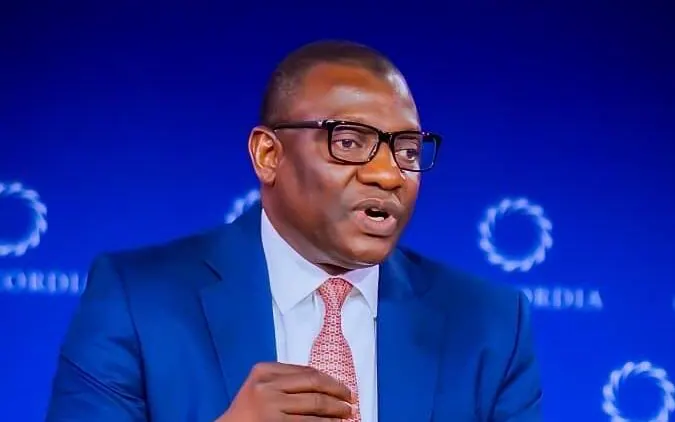
The Chief Executive Officer of World Energy Council Nigeria, Bala Wunti, has called on the Federal Government to ensure that the country's 44 critical minerals are developed into factories, jobs, and sustainable economic opportunities for Nigerians. He made this statement at the 2026 Concordia Annual Summit, held at the Sheraton New York Times Square alongside the United Nations General Assembly. Wunti emphasized that Nigeria must not repeat the crude oil model of exporting raw materials and importing finished products at significantly higher prices.
Wunti participated in a panel titled, “Rare Currency: Critical Minerals in a Shifting Global Economy,” which examined America’s growing dependence on imported minerals and China’s dominance of global mineral processing. The panel discussion highlighted the importance of critical minerals in the global economy and the need for countries to develop their mineral resources sustainably. As a former Chief Upstream Investment Officer at the Nigerian National Petroleum Company Limited, Wunti has extensive experience in the energy sector.
Wunti warned that Nigeria must move beyond exporting mineral tonnage and develop domestic processing and manufacturing capacity. He cited the example of crude oil, which Nigeria has been exporting for half a century, but has not created prosperity for the country. “For half a century, Nigeria exported crude oil and imported refined petroleum products. That created poverty, not prosperity. We will not repeat that mistake with lithium and rare earth elements,” he said.
According to Wunti, the absence of reliable geological data and commercially structured projects are major obstacles to Nigeria's full development of its mineral resources. He explained that investors invest in projects, not potential, and that Nigeria needs to present commercially viable transactions to investors rather than rely on policy documents and promotional presentations. Wunti identified the Nigerian Solid Minerals Company as the country’s flagship investment platform, established to transform mineral resources into bankable projects.
Wunti described the conditions necessary for attracting sustainable investment into the sector, including JORC compliant geological data, commercially viable prices, a stable and competitive fiscal system, and credible buyers. He emphasized that government can only make a project bankable, but cannot permanently make an uneconomic project profitable. Wunti also noted that private capital would be required to finance most critical mineral projects, while the government must create an environment that reduces investment risks.
The 2026 Concordia Annual Summit is a leading nonpartisan global forum that brings together influential leaders from government, business, and civil society to address pressing international challenges. Past speakers at the summit have included former US Presidents Joe Biden, George W. Bush, and Bill Clinton, former British Prime Minister Tony Blair, UN Secretary General António Guterres, and business leader Warren Buffett. The summit provides a platform for leaders to discuss critical issues and develop solutions.
Wunti concluded that Nigeria must present investors with defined projects and clear commercial propositions, and that a price floor of $110 per kilogram gives investors commercial certainty. This, he said, would enable Nigeria to attract processing facilities, create jobs, and retain greater value from its mineral resources. With the right approach, Nigeria can develop its 44 critical minerals into a sustainable and profitable industry that benefits the country and its people.
Key points
- Nigeria has 44 critical minerals that must be developed into factories, jobs, and sustainable economic opportunities for Nigerians.
- The country must move beyond exporting mineral tonnage and develop domestic processing and manufacturing capacity.
- Attracting private capital into the mining sector requires reliable geological data, clearly defined projects, enabling infrastructure, predictable regulation, credible developers, and viable routes to market.