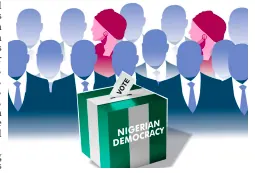
The Independent National Electoral Commission (INEC) has released its final list of candidates for the 2027 general election, sparking debates and challenges from candidates and political parties. The elections will fill positions in the presidency, senate, governorship, house of representatives, and state houses of assembly. Some candidates, like Gbenga Olawepo-Hashim of the Accord Party, have disputed their exclusion from the list. INEC, however, has denied any wrongdoing, stating that it published what was submitted by the political parties.
The deputy director of Voter Education and Publicity, Wilfred Ifogah, emphasized that INEC did not commit any infraction, as it handed over access codes to all parties to upload their candidates' names. Most cases of disputed candidates are attributed to internal party disputes being litigated in court. However, a more substantial issue is the significant underrepresentation of women in the electoral process. According to INEC's data, women constitute only 9.65% of candidates for all elections.
Out of 4,881 candidates cleared by INEC for the presidency, Senate, and House of Representatives, only 471 are women, while 4,410 are men, representing 90.35%. Tracy Ohovwore, Project Officer at Renevlyn Development Initiative, noted that even when women secure positions, they are often seen as mere tokens rather than deserving candidates. This leads to women's issues being treated with levity and taking a back seat in the political agenda.
The minimal inclusion and representation of women in government and politics in Nigeria reflect a deep and worrying trend in society. The country's political process increasingly disempowers women, which is concerning given the need for every citizen's contribution to the nation's peace and prosperity. Excluding women from political offices has a cost not only for them but also for the country, as it compounds the development deficit with every election cycle.
According to the Inter-Parliamentary Union, Nigeria ranks 180th out of 185 countries globally for women's representation in parliament. In sub-Saharan Africa, Nigeria has the lowest representation, with an average of 27.3% in the region. Rwanda, a continental exemplar, has achieved 61.3% women in its legislature. This disparity highlights the need for Nigeria to address its gender representation gap in politics.
Other countries in the region, such as Sierra Leone, have made progress in promoting gender equality in politics. Sierra Leone enacted a Gender Equality and Women's Empowerment Act in 2023, which led to women winning 30.4% of parliamentary seats within months. This demonstrates that with deliberate policies and actions, countries can improve women's representation in politics.
The low representation of women in Nigerian politics has become a consistent pattern under the current political dispensation. To address this issue, stakeholders must work together to promote women's participation and inclusion in the electoral process. This can be achieved through policy reforms, advocacy, and education to ensure that women's voices are heard and represented in the country's governance.
Key points
- Women constitute only 9.65% of candidates for the 2027 Nigerian general election.
- Nigeria ranks 180th out of 185 countries globally for women's representation in parliament.
- The country's low representation of women in politics has become a consistent pattern under the current political dispensation.