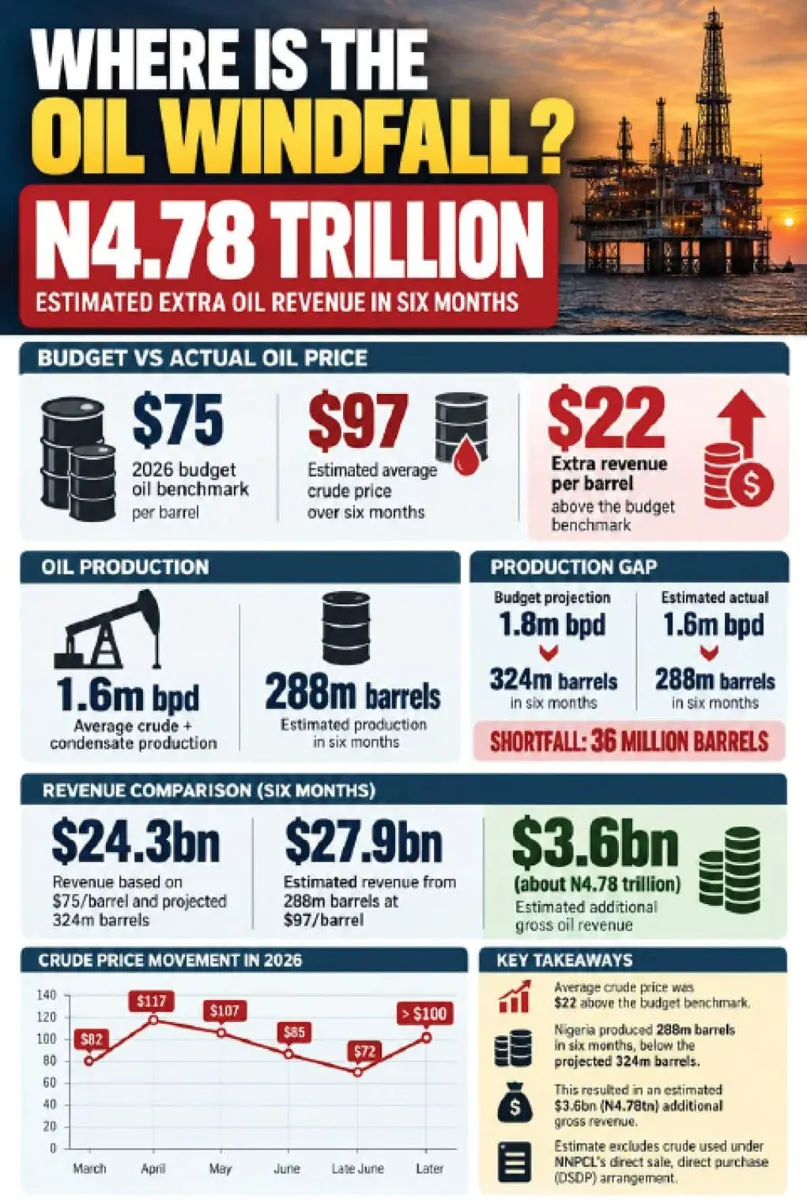
The ongoing US-Iran conflict has led to a significant increase in global oil prices, resulting in a substantial windfall for Nigeria, the country's largest oil producer in Africa. With Brent crude trading above $115 per barrel in April, Nigeria's oil earnings have surged. According to Daily Trust analysis, the country may have grossed around N5 trillion in the six months since the conflict began in late February 2026. This substantial increase in revenue presents an opportunity for Nigeria to bolster its finances.
The 2026 budget, initially set at N58.47 trillion, was based on a conservative crude benchmark of $64.85 per barrel, with oil production projected at 1.84 million barrels per day. However, with rising crude prices, the budget was later reviewed upward to N67.7 trillion. The Senate Committee on Appropriations increased the crude benchmark to $75 per barrel in April. With international crude prices now exceeding this benchmark, Nigeria has earned additional revenue. At an average of $97 per barrel over six months, Nigeria would have earned an extra $22 per barrel above the $75 projection.
Nigeria's crude oil and condensate production averaged around 1.6 million barrels per day during the period, falling short of the 2026 budget benchmark of 1.84 million barrels per day. Data from the Nigerian Upstream Petroleum Regulatory Commission (NUPRC) showed that the country produced an average of 1.68 million barrels per day in August, up from 1.67 million barrels per day in July. In July, combined crude and condensate production stood at 1.67 million barrels per day, comprising 1.505 million barrels of crude and 0.17 million barrels of condensate.
Based on the average production of 1.6 million barrels per day, Nigeria produced 48 million barrels in a month and 288 million barrels in six months, against 324 million barrels at a projected 1.8 million barrels per day. In revenue terms, Nigeria is estimated to have grossed $27.9 billion at an average of $97 per barrel and 288 million barrels, compared to $24.3 billion from the projected $75 per barrel and 324 million barrels. This leaves an excess of $3.6 billion, approximately N4.78 trillion.
The analysis excludes the existing crude swap arrangement, officially known as the direct sale, direct purchase (DSDP) scheme, introduced by the Nigerian National Petroleum Company Limited (NNPCL). Under this program, the Nigerian government took loans to be repaid through the sale of crude oil. It is estimated that around 300,000 barrels of crude oil have gone into this arrangement, but this could not be independently confirmed due to lack of response from the NNPCL.
Experts say the rising crude prices present a golden opportunity for Nigeria to increase revenue and provide safety nets for citizens bearing the brunt of high energy prices and the general cost of living. However, they observe that Nigeria would have gained more if it had achieved the projected 1.8 million barrels per day oil production target. Energy expert Oyebode Fadipe noted that the mathematical breakdown of the estimated $27.936 billion in gross receipts was technically correct based on the average crude price and production figures used.
Despite the surge in crude prices, Nigeria's Excess Crude Account (ECA) has shown little evidence of benefiting from the price surge. As of June 2026, the ECA stood at only $535,823.39, the same figure recorded in August 2025. The ECA was established as a buffer for saving oil revenues earned above the budget benchmark, but despite the surge in crude prices, there has been no substantial rebuilding of the account.
Key points
- Nigeria earns estimated N5 trillion in oil windfall since late February 2026
- Oil production remains below 2026 budget benchmark
- Excess Crude Account shows little evidence of benefiting from price surge