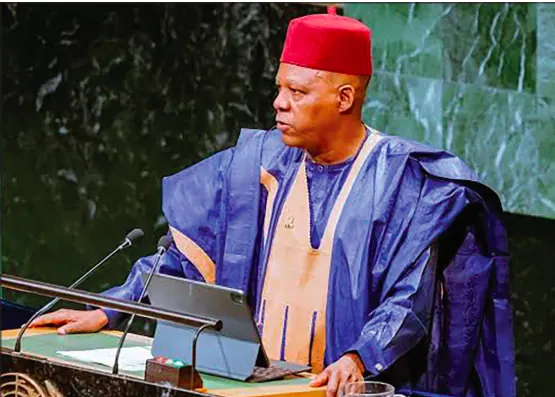
Nigeria's Vice President Kashim Shettima has made a strong case for Africa to have permanent representation on the United Nations Security Council. Speaking at the 81st UN General Assembly in New York on September 24, Shettima delivered a message that carried the aspirations and hopes of the African continent. He emphasized the need for comprehensive reform of the UN, starting with the reconstitution of the Security Council. Shettima's call for reform is aimed at addressing the historical imbalance in the council's membership.
The current composition of the UN Security Council consists of five permanent members - Russia, the United States, China, the United Kingdom, and France - and 10 non-permanent members elected on a two-yearly basis. Shettima argued that Africa cannot continue to contribute to the council's agenda without having a permanent seat. He made the case for at least two permanent seats for Africa, with all the rights and responsibilities of permanent membership, including veto power. This position is in line with the Ezulwini Consensus and the CFTA Declaration.
This was not the first time Shettima had made this call. He had previously made similar statements at the 79th and 80th UNGA sessions. The message has garnered considerable support from other African leaders. Kenyan President William Ruto, for instance, described the crisis of multilateralism as a crisis of rules and institutions that have not kept pace with the world they are expected to govern. Ruto condemned the situation where international law serves as a shield for some and a restraint for others.
Other African leaders have also expressed support for Nigeria's position. Ethiopian President Taye Atske Selassie questioned how a world led with a right conscience could justify denying 1.6 billion Africans equal representation. Liberian President Joseph Nyuma Boaki stated that the historical injustice could not continue and that changing the imbalance was not a favor for Africa but necessary to restore UN trust, credibility, and legitimacy. Ghana's President John Mahama also spoke in a similar vein, emphasizing that Security Council reform was not a favor to Africa.
The 81st session of the General Assembly was themed "Restoring Trust, Managing Transformation: A United Nations That Delivers for All." The theme reflects the need for the UN to adapt to changing global circumstances. Shettima's call for reform is part of a broader effort to make the UN more representative and equitable. The issue of UN reform has been on the agenda for many years, but progress has been slow.
The push for Africa's permanent representation on the UN Security Council is driven by a desire to address historical injustices and ensure that the continent has a stronger voice in global affairs. The UN's inability to reform its Security Council has been criticized by many as a major weakness. The current composition of the council does not reflect the diversity of the UN's membership.
The outcome of Nigeria's push for Africa's permanent representation on the UN Security Council remains to be seen. However, the fact that the issue is being raised at the highest levels of international diplomacy is a positive development. The international community will be watching closely to see how the UN responds to this call for reform.
Key points
- Nigeria's Vice President Kashim Shettima calls for Africa to have permanent seats on the UN Security Council.
- The push for Africa's permanent representation on the UN Security Council is driven by a desire to address historical injustices.
- The issue of UN reform has been on the agenda for many years, but progress has been slow.