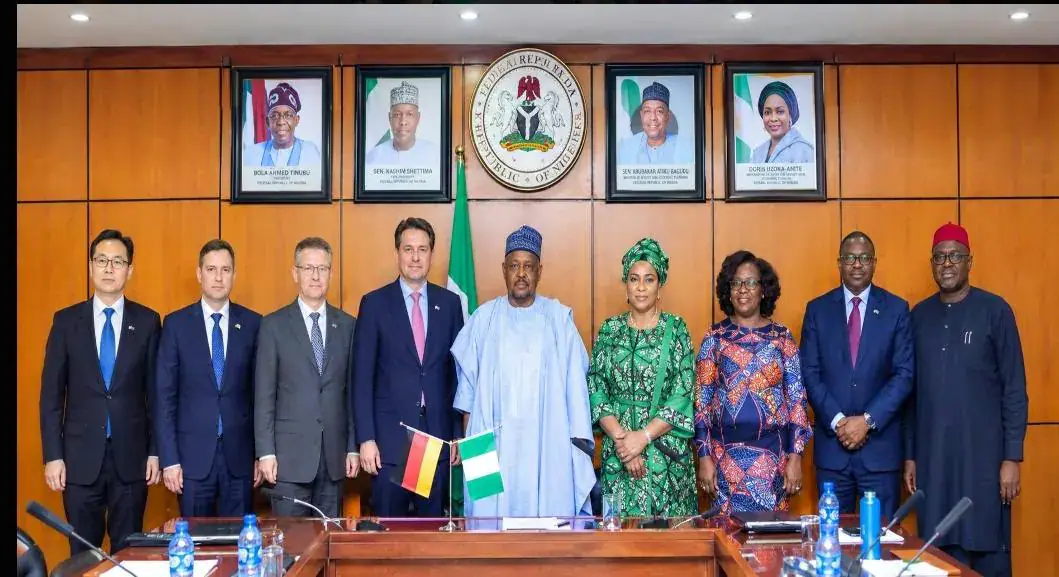
Nigeria and Germany are set to expand their economic partnership, with a focus on key sectors such as agriculture, renewable energy, industrial development, and vocational training. A high-level meeting in Abuja between Nigerian government officials and a German Bundestag Committee on Economic Cooperation and Development delegation aimed to boost investment and create jobs. The meeting, which took place on October 29, 2026, brought together top officials from both countries to discuss areas of mutual interest.
The Nigerian delegation, led by Minister of Budget and Economic Planning, Senator Abubakar Bagudu, included Minister of Agriculture and Food Security, Senator Abubakar Kyari, Minister of State for Industry, Senator John Enoh, and Minister of State, Doris Uzoka-Anite. The German delegation was led by Professor Wolfgang Stefinger. During the meeting, Bagudu emphasized the importance of expanding trade, attracting investment, and encouraging technology transfer between the two countries. He noted that Nigeria and Germany could benefit from sharing experiences in economic management, governance, and institutional development.
The Minister of Agriculture and Food Security, Kyari, reaffirmed the Federal Government's commitment to improving agricultural production and strengthening food security. He highlighted the need to reduce food imports and post-harvest losses, expand irrigation, improve access to agricultural finance, and introduce modern farming technologies. Supporting smallholder farmers, women, and young people through mechanization, research, and agribusiness opportunities was also stressed. This move aims to enhance Nigeria's food security and reduce its reliance on imported food.
On industrial development, Minister of State for Industry, Enoh, said Nigeria is committed to expanding manufacturing, entrepreneurship, digital innovation, and vocational training to strengthen local industries and create employment. He commended Germany, particularly its development agency, GIZ, for supporting skills development and institutional capacity-building in Nigeria. This partnership has contributed significantly to Nigeria's efforts to develop its industrial sector and create jobs.
Minister of State for Budget and Economic Planning, Uzoka-Anite, called for sustained development financing and stronger partnerships with German institutions to support infrastructure, agriculture, and youth empowerment. She identified renewable energy and industrialization as important areas for cooperation. Uzoka-Anite's remarks underscored the need for collaboration between Nigeria and Germany to address the country's development challenges.
Responding on behalf of the German delegation, Professor Stefinger reaffirmed Germany's interest in strengthening its relationship with Nigeria. He identified sustainable economic development, vocational education, security, renewable energy, and healthcare infrastructure as areas of interest. The discussions highlighted the importance of stronger institutions, improved economic management, and sustainable development financing in achieving long-term economic growth.
The renewed engagement between Nigeria and Germany is expected to provide opportunities for both countries to explore practical partnerships that could support investment, improve productivity, and strengthen economic relations. While the meeting did not announce a specific new investment amount or signed project agreement, it marked a significant step towards deepening economic cooperation between the two nations. Key areas of focus include food security, renewable energy, and vocational training.
Key points
- Nigeria and Germany have identified agriculture, renewable energy, industrial development, and skills acquisition as key areas for deeper collaboration.
- The meeting aimed to expand investment and create jobs in Nigeria.
- The renewed engagement is expected to provide opportunities for practical partnerships that could support investment, improve productivity, and strengthen economic relations.