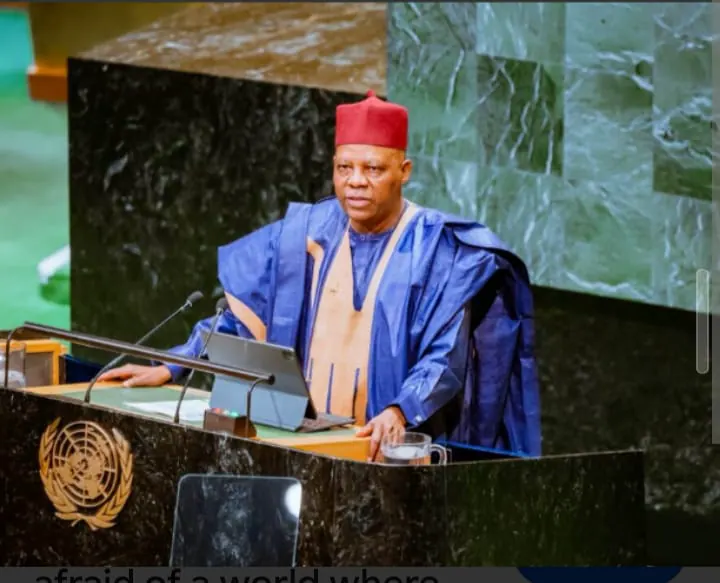
Nigeria has called for urgent reforms to the United Nations, emphasizing the need for stronger international cooperation and a renewed commitment to diplomacy, dialogue, and international law. Vice President Kashim Shettima made the appeal on behalf of President Bola Ahmed Tinubu at the 81st United Nations General Assembly in New York. The Vice President's address highlighted Nigeria's commitment to the UN Charter and its principles, stressing the importance of mutual respect and collective responsibility in addressing global challenges.
A key focus of Nigeria's address was the reform of the UN Security Council, with the country reiterating Africa's position for at least two permanent and five non-permanent seats on the Council. This, Nigeria emphasized, would ensure meaningful African representation in decisions on international peace and security, reflecting current global realities. The Vice President also highlighted Nigeria's contributions to international peacekeeping, including successful interventions in Liberia, Sierra Leone, Darfur, Mali, and The Gambia.
Nigeria's address also touched on economic development, linking its foreign policy to ongoing domestic reforms aimed at promoting sound macroeconomic management, stronger institutions, and private-sector development. The country called for reforms to the international financial architecture, seeking greater access to concessional financing and sustainable debt frameworks to support Africa's economic transformation. Additionally, Nigeria urged greater technology transfer, capacity building, and climate finance for developing countries.
The Vice President reaffirmed Nigeria's commitment to peace, security, and democratic governance through regional partnerships, including ECOWAS, the African Union, and the Gulf of Guinea. On trade and regional integration, Nigeria highlighted the African Continental Free Trade Area as critical to expanding intra-African trade, strengthening regional value chains, and promoting industrialization and value addition across the continent.
Nigeria also emphasized the need for stronger international cooperation against terrorism, organized crime, cyberattacks, and illicit financial flows. The country called for urgent diplomatic efforts to resolve conflicts in Sudan and other war-affected countries, with all parties expected to protect civilians, facilitate humanitarian access, and respect international humanitarian and human rights law.
In addition to its economic and security concerns, Nigeria reaffirmed its commitment to the Energy Transition Plan and the Paris Agreement, including its target of achieving net-zero emissions by 2060. The country also called for the responsible deployment of artificial intelligence to advance healthcare, education, agriculture, governance, and economic productivity.
In closing, Nigeria pledged to continue choosing cooperation over confrontation, dialogue over division, and partnership over isolation. The country called for a reformed, inclusive, and effective United Nations capable of restoring trust and advancing a peaceful, just, and sustainable world for present and future generations.
Key points
- Nigeria's Vice President Kashim Shettima calls for UN reforms, stronger international cooperation, and commitment to diplomacy and international law.
- Nigeria seeks reforms to the UN Security Council, including at least two permanent and five non-permanent seats for Africa.
- The country emphasizes the need for stronger international cooperation against terrorism, organized crime, and illicit financial flows.