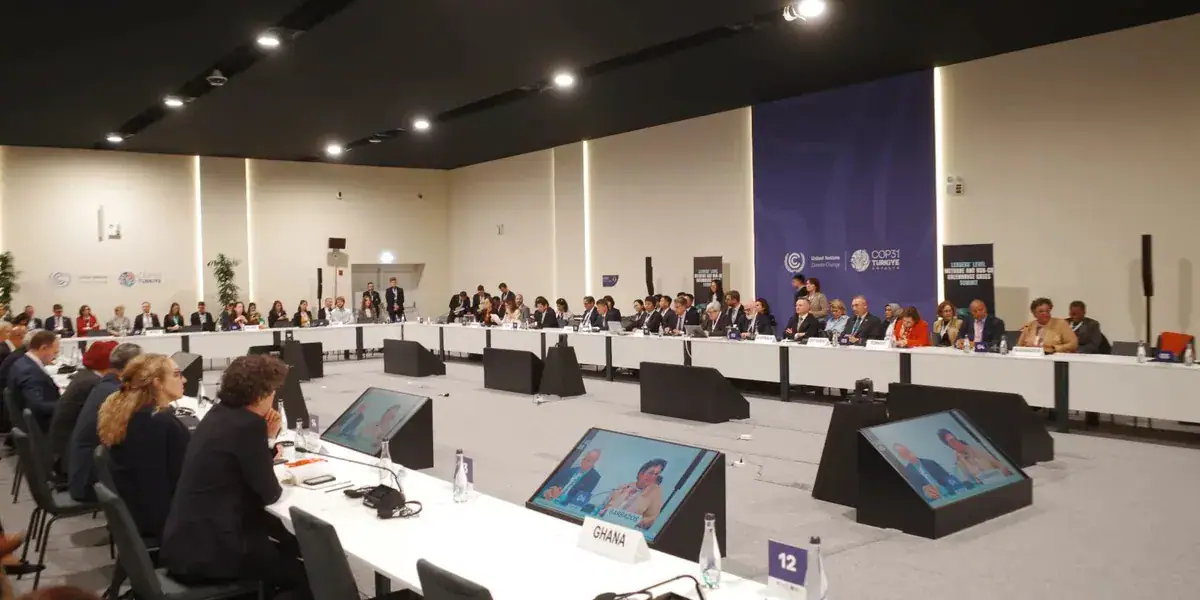
The Super Pollutant Country Action Accelerator, an international initiative, has targeted Nigeria and 13 other developing countries for support in reducing methane and other climate-warming pollutants. This initiative provides technical assistance, dedicated national teams, and support to develop investment-ready projects to help participating countries reduce emissions. The announcement was made at the Leaders’ Level Methane and Other Non-CO₂ Greenhouse Gases Summit at COP31 in Antalya, Türkiye.
The initiative, led by the Climate and Clean Air Coalition (CCAC), has secured $50 million in announced funding and aims to support 30 developing countries by 2030. UK Climate Minister Katie White announced an additional $25 million to expand the initiative to seven more countries: Côte d’Ivoire, Ethiopia, Fiji, Morocco, Pakistan, the Philippines, and Uzbekistan. These countries join Brazil, Cambodia, Indonesia, Kazakhstan, Mexico, Nigeria, and South Africa, which were the initiative’s first beneficiaries announced at COP30.
The programme is designed to help participating countries translate their commitments to reduce methane and other super pollutants into practical action. This is achieved through technical assistance and the development of projects capable of attracting investment. The initiative focuses on providing support to countries in developing and implementing projects that can reduce emissions and mitigate the impacts of climate change.
Global efforts to reduce methane and other non-CO₂ greenhouse gases are gaining momentum. At the summit, philanthropies announced over $480 million in new funding to support emissions reductions across the energy, agriculture, and waste sectors. This funding adds to the over $530 million already delivered by philanthropic organisations since the launch of the Global Methane Pledge in 2021.
The Leaders’ Level Methane and Other Non-CO₂ Greenhouse Gases Summit was co-hosted by Brazil, China, and the United Kingdom, alongside the COP31 Presidency. The summit was chaired by UK Secretary of State for Energy Security and Net Zero, Ed Miliband. Participants included senior representatives of international organisations and country leaders, such as Barbados Prime Minister Mia Mottley and Australia’s Minister for Climate Change and Energy, Chris Bowen.
Speakers at the summit highlighted the economic opportunities and feasibility of reducing methane emissions. Fatih Birol, Executive Director of the International Energy Agency (IEA), stated that at least 75 per cent of methane emissions from fossil fuel operations could be reduced using existing technologies. Ajay Banga, President of the World Bank Group, mentioned that the bank was supporting methane reduction programmes in 45 countries, aiming to reduce 11 million tonnes of methane emissions and benefit over 160 million people.
The summit emphasised the importance of cutting methane and other non-CO₂ greenhouse gases to limit global temperature rise. Methane is a potent greenhouse gas that contributes significantly to global warming. Reducing its emissions can help slow the rate of warming in the near term. The Super Pollutant Country Action Accelerator is one of several initiatives helping countries move from commitments to implementation.
Key points
- The Super Pollutant Country Action Accelerator has secured $50 million in funding to support 30 developing countries in reducing methane emissions by 2030.
- The initiative provides technical assistance, dedicated national teams, and support to develop investment-ready projects to help participating countries reduce emissions.
- Philanthropies have announced over $480 million in new funding to support emissions reductions across the energy, agriculture, and waste sectors.