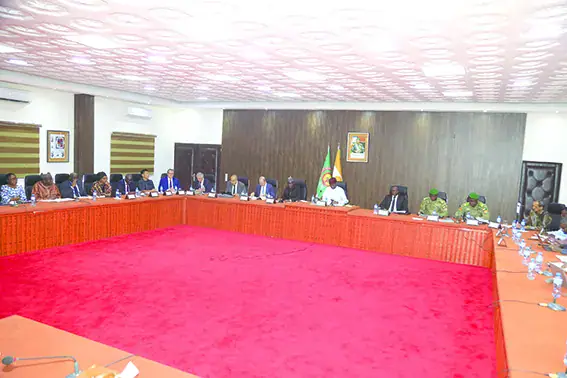
On Thursday, November 12, 2026, Niger's Prime Minister, Ali Mahaman Lamine Zeine, held a working session with a World Bank delegation at his office. The meeting focused on three key sectors for Niger's development: energy, agriculture, and water. Ministers responsible for Economy and Finance, Agriculture and Livestock, and Energy were also in attendance. The World Bank's Vice President for West and Central Africa, Ousmane Diagana, led the delegation.
The energy sector was a major topic of discussion, with the World Bank aiming to increase access to electricity for Nigeriens at an affordable cost and with satisfactory service quality. This initiative seeks to enable populations, families, and economic actors to develop their activities in a more secure environment. The World Bank's goal is to support Niger's efforts to provide reliable and accessible energy.
The agriculture sector was another key area of focus, with the World Bank seeking to help Niger address food insecurity and create jobs in the agricultural sector. The initiative aims to improve the incomes of small producers by enabling them to become entrepreneurs and establish small and medium-sized enterprises. This will contribute to the country's economic growth and development.
The importance of water was also emphasized, as it is essential for life and the development of the energy and agriculture sectors. Ousmane Diagana highlighted the critical role of water in electricity production and agricultural development, stating that "no individual can live without water. Water is life." The Niger government and the World Bank have developed a pact to identify urgent reforms and investments needed to make water accessible to all.
The pact between Niger and the World Bank aims to identify reforms, public investments, and environmental frameworks necessary to ensure water accessibility. The goal is to complement public sector efforts to make water a resource available to all, supporting agricultural development and energy production. This initiative will help address the country's water challenges and promote sustainable development.
The meeting between the Niger government and the World Bank delegation demonstrates the country's commitment to addressing its development challenges. The World Bank's initiatives in the energy, agriculture, and water sectors will support Niger's efforts to achieve sustainable development and improve the living standards of its citizens. The partnership between Niger and the World Bank is expected to yield positive results.
The Niger government and the World Bank have launched a new partnership framework for 2026-2031, which includes a $250 million project to support small and medium-sized enterprises. This project will help promote economic growth and development in the country. The partnership between Niger and the World Bank is expected to have a positive impact on the country's development trajectory.
Key points
- World Bank to support Niger's development in energy, agriculture, and water sectors
- Niger and World Bank launch new partnership framework for 2026-2031
- $250 million project to support small and medium-sized enterprises in Niger