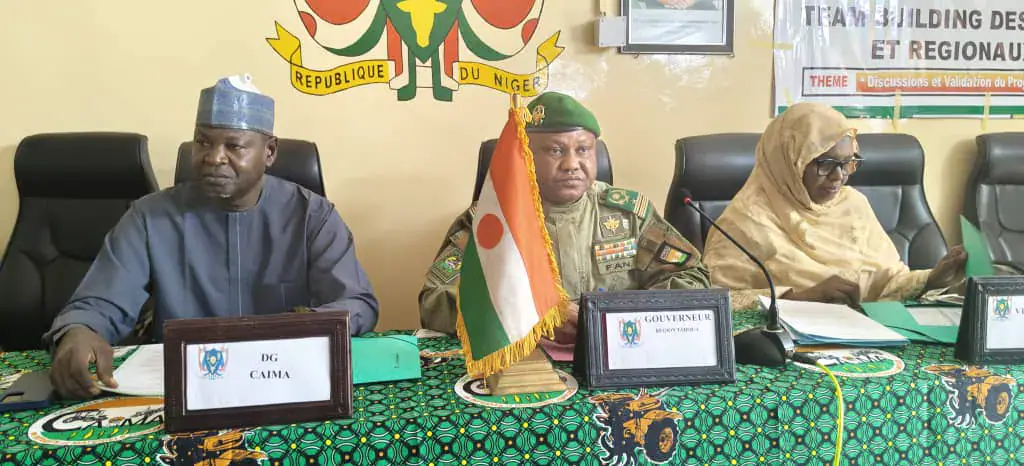
The Governor of Tahoua Region, Colonel-Major Souleymane Amadou Moussa, chaired the opening ceremony of a workshop to examine and validate the 2027 Work and Budget Plan of CAIMA. The event took place on November 28, 2026, at the Tahoua Governorate. This session is being held alongside a team-building exercise for central and regional cadres of the public institution. The Governor emphasized that the workshop is crucial in the current national context, where food and nutritional sovereignty, agropastoral development, and rural resilience are top priorities.
The Governor noted that under the leadership of General Abdourahamane Tiani, President of the Republic, the country's highest authorities are committed to making significant changes. CAIMA plays a strategic role in supplying rural areas with necessary agricultural inputs and equipment to improve productivity and develop production systems. The Tahoua Region, with its economy primarily based on agriculture and livestock, is particularly concerned with these issues. The Governor stressed that the availability of agricultural inputs at affordable prices and in sufficient quantities is essential for improving agro-sylvo-pastoral production and food security.
For the 2026 agricultural campaign, the Tahoua Region received significant allocations of inputs, including 7,201.2 tons of fertilizer, 1,300 tons of livestock feed, and 310 tons of improved seeds. These allocations aim to support producers and livestock owners in the region, addressing the challenges posed by the current year's fodder deficit. The Governor praised the efforts made by CAIMA and its partners in strengthening the region's supply of agricultural inputs.
However, the Governor also highlighted the need for effective accessibility of these inputs to the final beneficiaries, particularly producers and livestock owners in the most remote rural areas. He emphasized that the validation of CAIMA's 2027 Work and Budget Plan is a critical moment in ensuring that the institution's strategies align with the needs of the region's agricultural and livestock sectors.
The workshop brings together stakeholders to review and validate CAIMA's 2027 Work and Budget Plan, ensuring that it addresses the region's specific needs and priorities. The plan is expected to outline strategies for improving the availability and accessibility of agricultural inputs, as well as initiatives to support producers and livestock owners in the region.
The event is also an opportunity for CAIMA to strengthen its collaboration with regional stakeholders and ensure that its activities are aligned with the country's broader development goals. By validating the 2027 Work and Budget Plan, CAIMA aims to enhance its contribution to the region's agricultural and livestock sectors, ultimately improving food security and rural resilience.
The Governor's emphasis on the importance of accessibility and effective distribution of agricultural inputs underscores the challenges faced by rural communities in Niger. The validation of CAIMA's 2027 Work and Budget Plan is a critical step towards addressing these challenges and ensuring that the institution's efforts have a meaningful impact on the lives of producers and livestock owners in the region.
Key points
- CAIMA's 2027 Work and Budget Plan aims to improve the availability and accessibility of agricultural inputs in Niger's rural areas.
Reporting sources
- Tahoua : La CAIMA en session ordinaire sur l’examen et la validation du PTBA 2027 · Agence Nigérienne de Presse