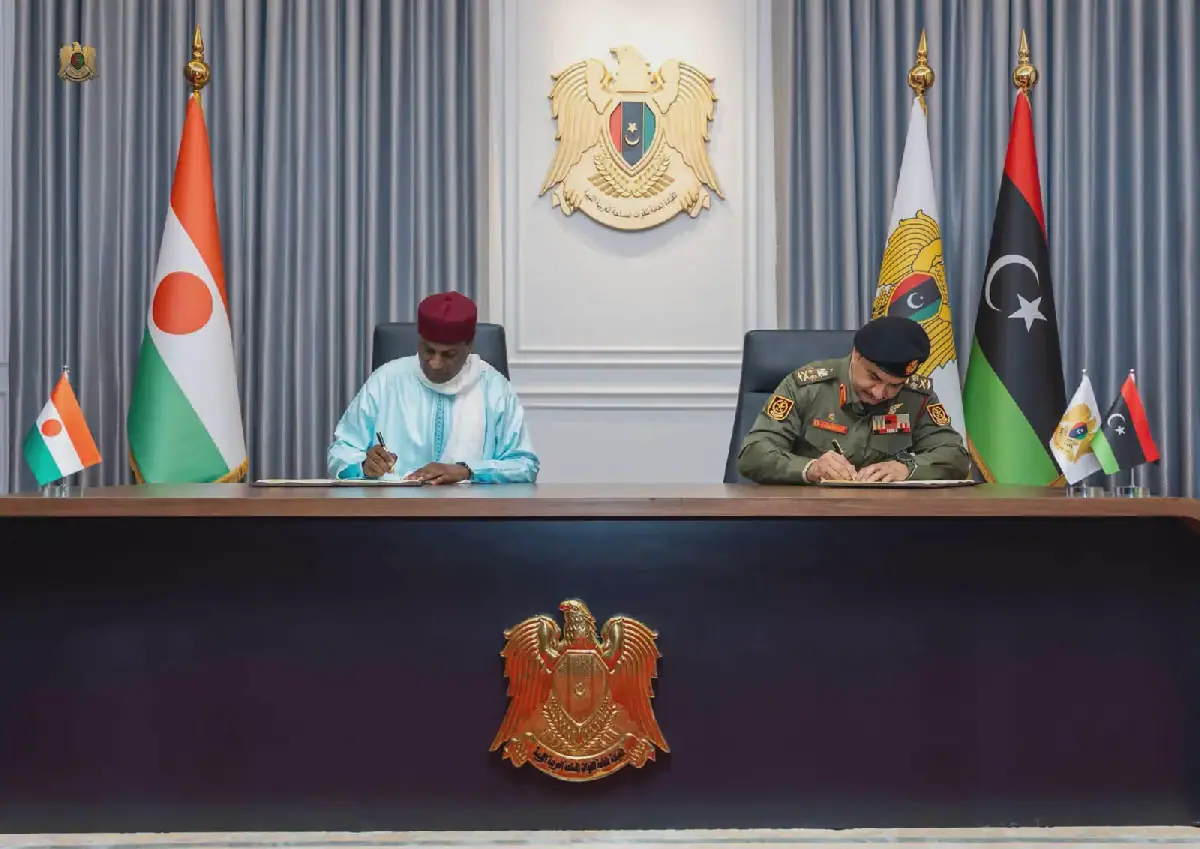
On Sunday, Niger and Libya's eastern government signed a protocol agreement for strategic cooperation, with both parties pledging to continue consultation and coordination. The agreement was signed by Lieutenant General Sadam Haftar, deputy commander of the Libyan eastern forces, and Nigerien Prime Minister Ali Mohamed Al Amin Zein. The meeting was attended by Libyan Prime Minister Osama Hamad and a Nigerien delegation comprising military and political leaders.
According to the Libyan News Agency, the two sides discussed ways to strengthen bilateral relations and expand areas of cooperation. They emphasized the depth of historical and cultural ties, as well as good neighborly relations between Libya and Niger. The Nigerien Prime Minister stated that the agreement aimed to expand cooperation in various fields, with a focus on enhancing security and economic collaboration.
The agreement's details have not been officially disclosed, but sources indicate that it includes a strategic cooperation pact on security, military, and intelligence matters. This pact covers border security, intelligence sharing, and coordination to combat smuggling and organized crime. A joint military and security force is to be established, with fixed deployment points along the border between the two countries.
The agreement also involves the opening of a Nigerien consulate general in Benghazi and a Libyan consulate general in Agadez, Niger. Furthermore, the two countries have agreed to facilitate trade and commercial exchange across their shared border, enhancing Libya's role as an economic and commercial hub towards the Mediterranean. This development is expected to benefit Niger, a landlocked country without a sea outlet.
The agreement is also expected to increase trade between the two countries, support their national economies, and promote the role of businessmen and investors. These developments are seen as paving the way for the launch of a direct air line between Benghazi and Niamey, the Nigerien capital. Niger maintains relations with both the Tripoli and Benghazi governments.
The Nigerien government faces challenges from armed groups along its border with Libya, which oppose the military junta that took power in 2023. These groups, supporting the ousted President Mohamed Bazoum, have carried out attacks against the Nigerien army and a major oil pipeline transporting crude oil to a Benin port.
The new agreement reflects efforts by Niger and Libya's eastern government to strengthen cooperation and stability in the region. Both parties have emphasized their commitment to implementing the agreed-upon obligations, serving the common interests of their countries and peoples.
Key points
- The agreement aims to enhance security cooperation and economic ties between Niger and Libya's eastern government.
- A joint military and security force is to be established to combat smuggling and organized crime along their shared border.
- The agreement is expected to increase trade and promote economic development in both countries.