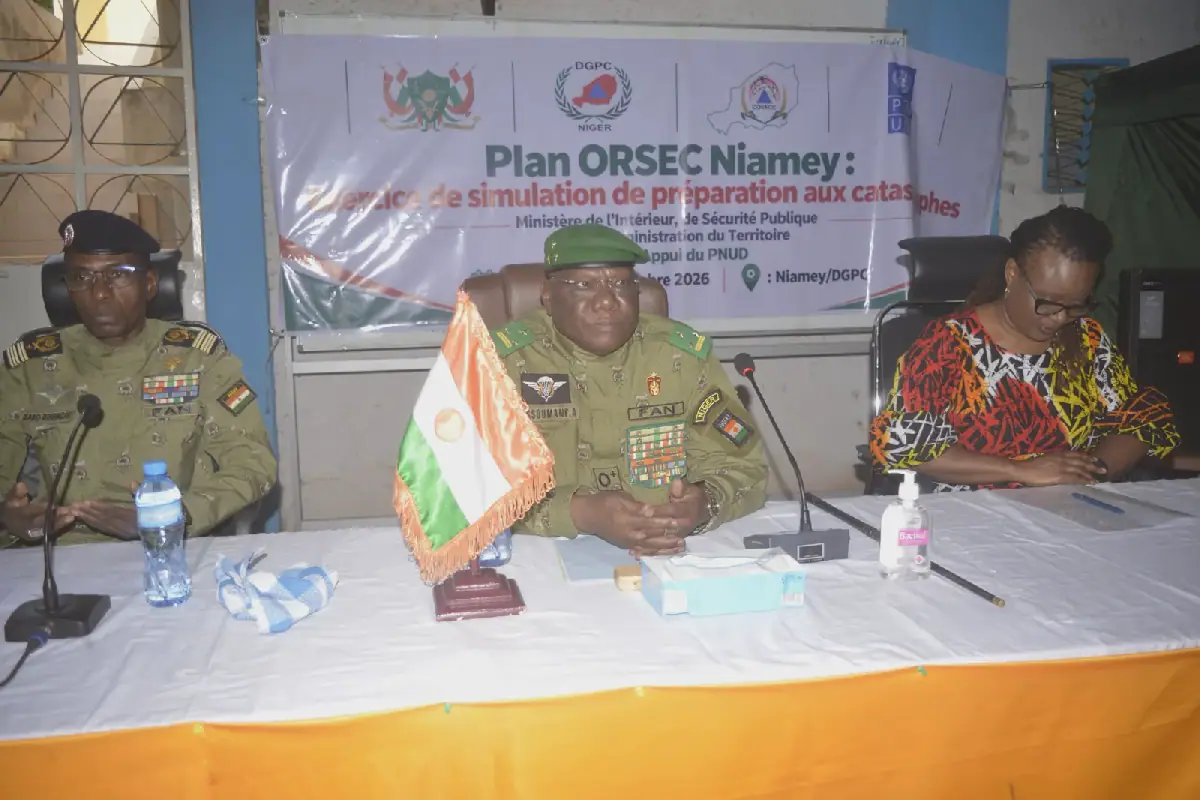
The Direction Générale de la Protection Civile, in collaboration with the Programme des Nations Unies pour le Développement (PNUD), organized a two-day disaster preparedness simulation exercise in Niamey from September 23-24, 2026. The exercise, which is part of the implementation of the Plan d'Organisation de Secours (ORSEC) at the regional level, simulated a mixed flood event, both fluvial and pluvial, in several localities near the river and neighborhoods of Niamey.
The simulation exercise aimed to prepare cells to respond to disasters by receiving and processing information, submitting it to the Chef du Centre de Coordination des Opérations régionales (CCO), and elaborating recommendations. The exercise was launched by the gouverneur de la région de Niamey, le général de division Assoumane Abdou Harouna, who emphasized that the exercise is an essential tool for testing the level of preparedness and coordination of all actors involved.
According to Harouna, the success of the exercise relies on a realistic scenario and practical situation, requiring perfect communication, better coordination, and real-time decision-making. He also highlighted that the Plan ORSEC is the only tool that organizes a collective response adapted to emergency situations and catastrophes, requiring a coordinated response under a single direction.
Le Directeur général de la Protection civile, le Colonel-major Bako Boubacar, stated that the exercise aims to test the capacity of the Centre de Coordination des Opérations de la région (CCO), interopérabilité on the ground, and identify gaps, strengths, and weaknesses of actors in communication and coordination in victim care.
La représentante résidente adjointe du PNUD, Mme Jane O. Yeboh, declared that the exercise offers an opportunity to test the operationality of ORSEC devices and communal safeguard, strengthen coordination between actors, and identify necessary improvements to be better prepared for potential crises. She also reaffirmed the PNUD's support in this area, providing technical expertise and facilitating the sharing of regional best practices.
The second day of the exercise was dedicated to a visit to the selected site located at the École Nationale de protection civile. This site will serve as a testing ground for the implementation of the ORSEC plan in the event of a disaster. The exercise will help identify areas for improvement and strengthen the capacity of national and local actors in disaster management.
The simulation exercise is a critical component of Niger's disaster preparedness efforts, and its success will depend on the collaboration and coordination of all actors involved. The exercise will also help to raise awareness about the importance of disaster preparedness and response, and the role that each actor plays in this process.
Key points
- The exercise simulated a mixed flood event in several localities near the river and neighborhoods of Niamey.
- The Plan ORSEC is the only tool that organizes a collective response adapted to emergency situations and catastrophes.
- The PNUD reaffirmed its support in disaster preparedness efforts, providing technical expertise and facilitating the sharing of regional best practices.