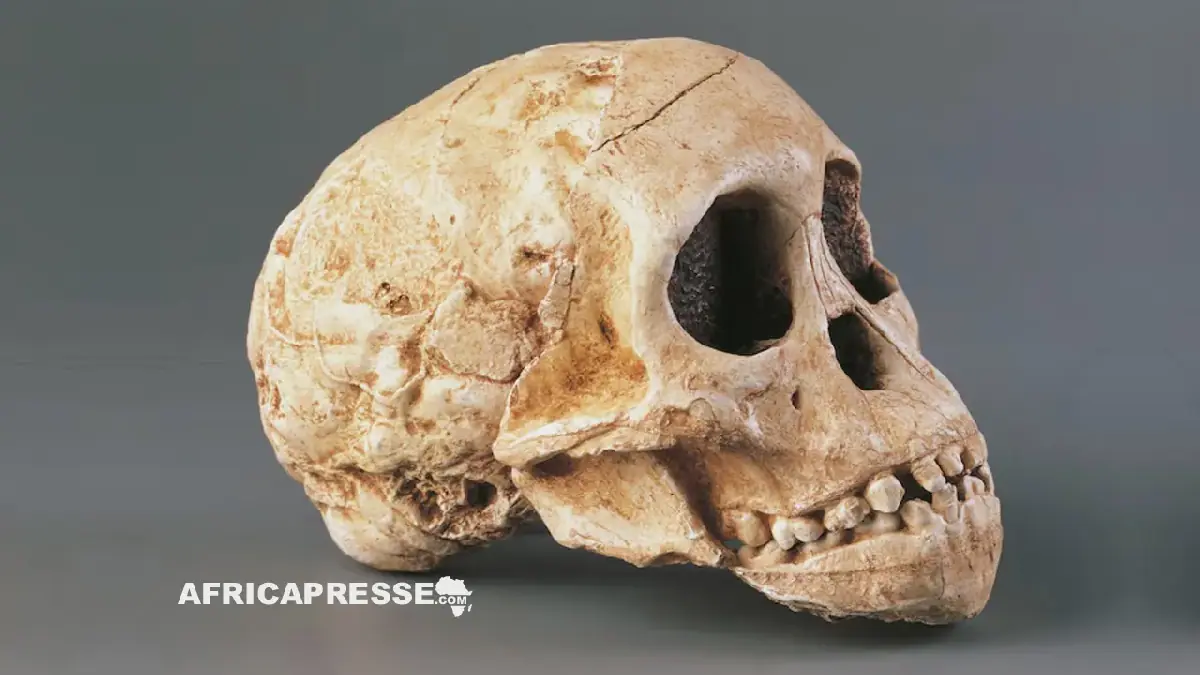
A new study led by researcher Gabriele Macho from the Vrije Universiteit Brussel has cast doubt on the significance of the Taung child fossil, a 2.5 million-year-old specimen discovered in South Africa in 1924. For decades, the Taung child has been considered a key example of the species Australopithecus africanus, a crucial part of human evolution. However, the study reveals that the fossil's developmental path may not be representative of the species as previously thought.
The study analyzed the development of the Taung child's dentition and brain, comparing it to other adult fossils attributed to the same species. The results show that several adult fossils traditionally classified as Australopithecus africanus exhibit different developmental patterns than the young Taung child. This suggests that hominids living in the same region may have followed distinct biological trajectories, challenging the idea of a single, linear human lineage.
The findings imply that multiple species may have coexisted or succeeded each other in the Sterkfontein region, a major paleoanthropological site in South Africa's "Cradle of Humanity." The study's authors attribute these evolutionary differences to changing climate conditions, with alternating wet and dry periods altering the landscape and fragmenting hominid habitats. This dynamic environment may have led to isolated populations evolving differently and adapting to new pathogens and predators.
The research questions the traditional linear representation of human evolution, instead suggesting a complex network of relationships between different hominid populations. As hominids moved in response to habitat expansion and contraction, isolated populations may have developed distinct characteristics before interbreeding and adapting to their environments. This nuanced understanding of human evolution may lead to a reevaluation of the classification of many South African fossils and a reexamination of the region's settlement scenarios.
The study's implications extend beyond the Taung child fossil, urging caution when constructing simplified family trees and emphasizing the importance of considering diverse evolutionary trajectories within a given geographic area. Further genetic and morphological analysis will be necessary to confirm these hypotheses and clarify the relationships between different Sterkfontein hominid populations. For now, the "Cradle of Humanity" appears to be a more complex and multifaceted place than previously thought.
The research has significant implications for our understanding of human origins, suggesting that the emergence of humanity may have been a more complex and dynamic process than previously thought. The study's findings highlight the need for a more nuanced understanding of the relationships between different hominid populations and the environmental factors that shaped their evolution. By reexamining the fossil record and incorporating new evidence, scientists may be able to build a more accurate picture of human evolution.
The study's authors hope that their findings will contribute to a more comprehensive understanding of human evolution, one that takes into account the complexity and diversity of hominid populations. By challenging traditional views of human origins, the research may pave the way for new discoveries and a deeper understanding of the human story. As scientists continue to analyze the fossil record and explore the complexities of human evolution, our understanding of the human past may continue to evolve.
Key points
- The study challenges the long-held status of the Taung child fossil, suggesting a more complex human evolution.