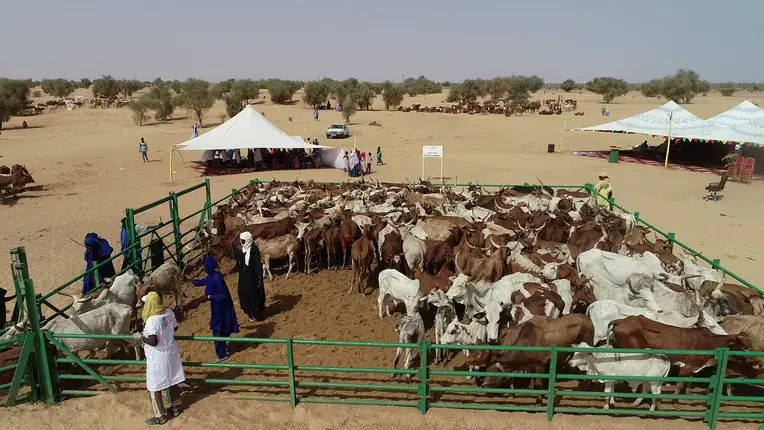
The Malian government has officially announced the launch of a new animal vaccination campaign for the 2026-2027 period. The campaign aims to vaccinate approximately 88.7 million heads of animals and poultry, marking a 6.4% increase from the previous year's target of 83.4 million. The official launch event is scheduled to take place on December 12 at the Zantiguila livestock market in the rural commune of Marakacoungo.
The vaccination campaign is part of the government's efforts to improve animal health coverage and disease surveillance in the country. According to the government, the campaign will help reduce the impact of animal diseases on livestock production and improve the livelihoods of families dependent on animal husbandry. The campaign's target includes all types of animals and poultry, but it remains unclear whether each head will be counted only once or if multiple vaccinations administered to the same animal will be included in the tally.
The previous vaccination campaign, which took place in 2024, had a target of 76.9 million animals and achieved a vaccination rate of 53.43%, with 41.1 million animals vaccinated. Although the results of the previous campaign provide some insight into the country's vaccination efforts, it is unclear whether the same conditions and strategies will be applied in the current campaign. The government has not yet disclosed the budget, cost to farmers, or the schedule for veterinary teams.
The vaccination campaign is particularly crucial in areas with high levels of transhumance, where livestock move over long distances. In these areas, animal health is a significant concern, and vaccination campaigns can help prevent the spread of diseases. The government has not yet provided a breakdown of the vaccine doses allocated to each region, species, or disease, which would be useful information for farmers and veterinary teams.
Animal diseases remain a significant challenge in Mali, with several diseases still prevalent in the country. In December 2025, the Ministry of Agriculture cited several animal diseases, including those affecting small ruminants, and emphasized the importance of animal identification and marking. It is unclear whether these components will be included in the current campaign.
The success of the vaccination campaign will be measured by the level of coverage achieved, which will be compared to the target of 88.7 million heads. The campaign's impact on animal health, livestock production, and farmers' livelihoods will also be closely monitored. For families dependent on animal husbandry, the health of their livestock directly affects their income, milk production, and losses due to animal diseases.
The government has not yet provided detailed information on the quantities of vaccines available or the cost to farmers. Further details on the campaign's implementation, including the schedule for veterinary teams and the allocation of vaccine doses, are expected to be announced in the coming weeks. The vaccination campaign is a critical step towards improving animal health and reducing the impact of animal diseases in Mali.
Key points
- The campaign aims to vaccinate 88.7 million heads of animals and poultry, a 6.4% increase from the previous year's target.
Reporting sources
- Vaccination animale : Démarrage d’une nouvelle campagne · Le Journal du Mali