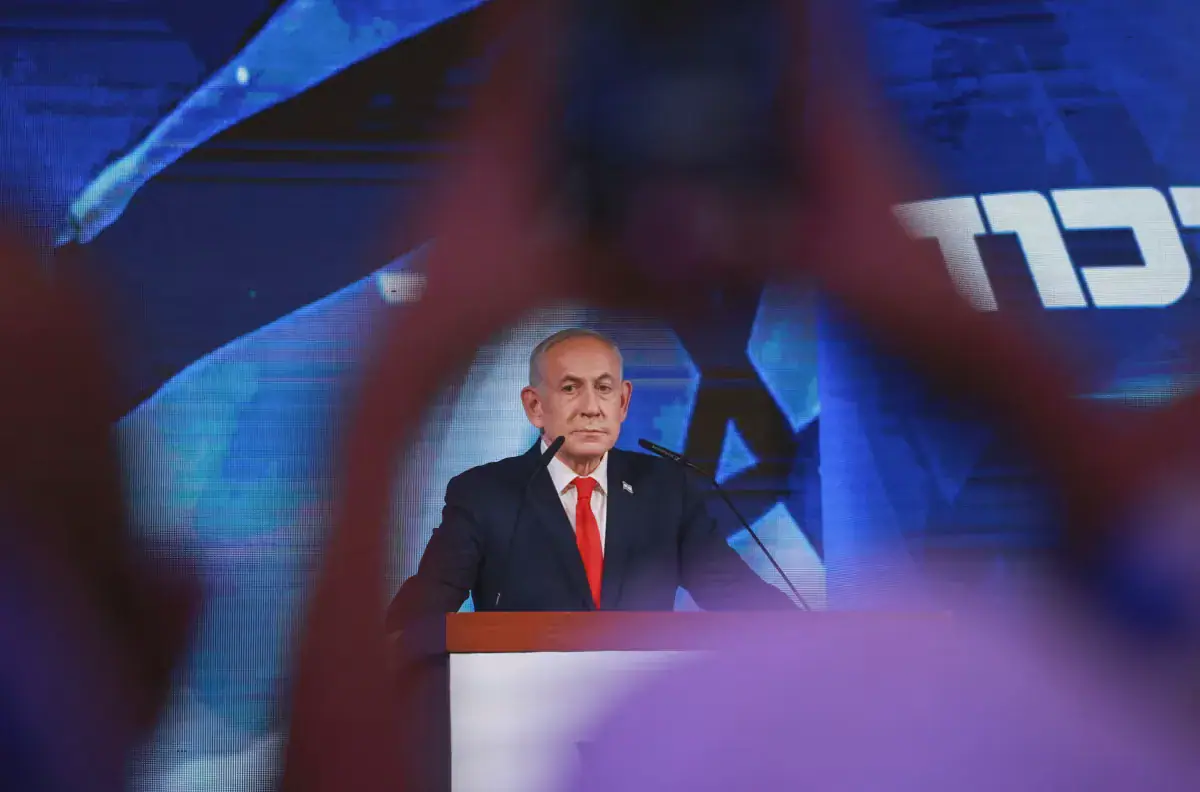
Israeli Prime Minister Benjamin Netanyahu's political survival is uncertain after the country's latest election. With most votes counted, Netanyahu's Likud party has 26 seats, making it the largest party in the 120-seat Knesset. However, his right-wing bloc has lost its majority, with an estimated 53 seats, short of the 61-seat majority needed to govern. This sets up weeks, possibly months, of political negotiations that will determine Netanyahu's future.
The opposition, led by Gadi Eisenkot, has 21 seats, but the Jewish opposition parties total only 48, falling short of victory. To reach 61 seats, they would need the support of two Arab parties, Raam and the Joint List, projected to win 19 seats. Analysts attribute the record turnout by Arab citizens of Israel to a backlash against four years of far-right national security policies that led to increased crime in the Arab community.
The Arab parties, Raam and the Joint List, are crucial to forming a government. Raam's leader, Mansour Abbas, became the first Arab politician to join an Israeli government in 2021. The Joint List combines several smaller parties, including the Communist Hadash, secularist Taal, and nationalist Balad factions. The Joint List has stated it is ready for political cooperation to bring Netanyahu's rule to an end.
Netanyahu's main post-election goal is to prevent the Jewish-Arab political cooperation that could end his rule. A source close to Netanyahu said he plans to delegitimize and prevent this cooperation by all means, including launching an attack on Iran or enlisting US President Donald Trump's intervention. Likud has accused the Arab parties of "stealing the election" through bribery, threats, violence, and forgery.
The opposition fears Netanyahu could use a security crisis to stall or block a new government. Before the election, Netanyahu pressed Trump to launch a joint attack on Iran, but Washington held off. An Israeli security source said operational plans are ready and awaiting Trump's approval. The opposition is aware that Netanyahu may try to push for another escalation.
Eisenkot, a former Israel Defense Forces chief of staff, called on Israel's security chiefs to remember that Netanyahu is a caretaker prime minister without a mandate or public confidence. Eisenkot declared that the public "has chosen change" and remains committed to bringing change to Israel. The next step is for President Isaac Herzog to consult with all elected parties and choose a candidate to form a government.
The chosen candidate has 28 days, with a possible 14-day extension, to negotiate with other parties and form a government. If they fail, the mandate passes to another candidate, and if that fails, the Knesset has a short window to put forward an alternative candidate. If all else fails, the country goes to automatic elections, with Netanyahu remaining as caretaker prime minister.
Key points
- Netanyahu's Likud party has 26 seats, but his right-wing bloc has lost its majority.
- The opposition needs the support of Arab parties to form a government.
- Netanyahu plans to prevent Jewish-Arab cooperation to survive politically.