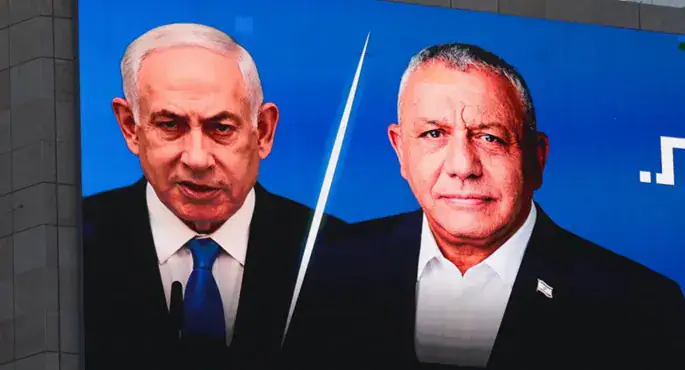
Israeli Prime Minister Benjamin Netanyahu is preparing to announce his willingness to serve as prime minister in a rotation agreement with Gadi Eisenkot, leader of the National Unity Party. This move is part of efforts to form a national unity government. According to Israeli media, Netanyahu's office has conveyed this offer through unofficial channels, allowing his Likud party to potentially distance itself from the deal. There are divisions within Netanyahu's inner circle regarding this step.
Eisenkot remains highly skeptical of Netanyahu's offer and continues to prepare for a new government to be sworn in next week. He has until December 6 to form a government, and he can also request a 14-day extension from the Israeli president. Meanwhile, Avigdor Lieberman, leader of the Yisrael Beiteinu party, warned on Friday that Netanyahu may propose a rotation deal to Eisenkot as a maneuver to block the formation of a new government without Likud.
Lieberman expressed concerns that Netanyahu is seeking to delay negotiations on forming a unity government until the last minute, then use it as a pretext to halt the process and call for new elections. He believes that even if a unity government is formed with Likud's participation, Netanyahu will try to create a crisis within months and return Israel to the polls. According to reports, Eisenkot has committed to his coalition partners, including Lieberman and Yair Golan, not to pursue a unity government with Netanyahu without their consent.
Netanyahu's offer has been met with skepticism by some in his own party. The Likud party has rejected requests to discuss the formation of a government that would include a rotation agreement or the exclusion of extremist elements. Eisenkot has emphasized that his camp is willing to make concessions to form a unity government, but he accuses Likud of not engaging in serious negotiations. He stated that the two sides have only met five times in the past two weeks and that Likud has refused to discuss key issues.
Eisenkot has outlined several conditions for a unity government, including the formation of a state investigative committee into the failures surrounding the October 7, 2023, Hamas attack and a discussion on legislation to impose military or national service on all citizens. He described Likud's proposal as "the worst" option, involving the same government, partners, and no changes. Eisenkot emphasized that he is open to negotiations if Likud is willing to engage in serious talks and make concessions.
The National Unity Party, led by Eisenkot, has 48 seats, short of the 61-seat majority required. To bridge this gap, Eisenkot may rely on support from Arab parties, religious parties, or a combination of both. His preferred option appears to be forming a coalition with the ultra-Orthodox party United Torah Judaism and the Arab party Ra'am. However, this would contradict campaign promises made by some in Eisenkot's camp not to partner with these parties.
As negotiations continue, Eisenkot is set to meet with Naftali Bennett, leader of the Yamina party, on Sunday. The two discussed a potential coalition agreement, with Bennett expressing openness to exploring alternative options if negotiations with Likud fail. The outcome of these talks remains uncertain, with implications for Israel's political landscape.
Key points
- Netanyahu's offer of a power-sharing deal to Eisenkot is seen as a maneuver to delay or block the formation of a new government.
- Eisenkot remains skeptical of Netanyahu's intentions and has outlined conditions for a unity government.
- The National Unity Party requires additional support to achieve a majority in the Israeli parliament.