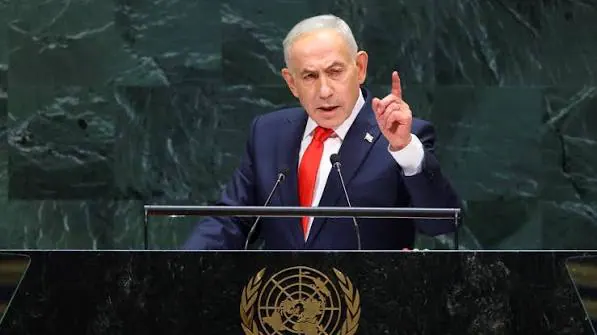
Israeli Prime Minister Benjamin Netanyahu delivered a contentious address to the United Nations General Assembly, marked by the walkout of numerous diplomats before he began speaking. The Israeli leader responded to the empty seats and departing delegates with characteristic hostility, stating, "If there are any other moral cowards who haven’t left the hall, please do so now." Netanyahu vowed to press forward with Israel's military campaigns despite mounting international condemnation, declaring, "We’re going to win. We have no other choice."
Netanyahu launched a sweeping verbal attack against international critics, dismissing accusations of colonialism and war crimes. He targeted European nations, remarking, "They accuse Israel, tiny Israel, of colonialism – some colonialism. And who’s accusing us? Among them are people in Britain and in France. For God’s sake, they invented the term." The prime minister also targeted Turkish President Recep Tayyip Erdogan, labeling him a tyrant and accusing him of backing Hamas.
Turkish communication officials swiftly denounced Netanyahu's UN address, presenting baseless accusations. The prime minister shifted focus to domestic and local political pressures, targeting New York City Mayor Zohran Mamdani and accusing him of cultivating an unsafe environment for Jewish residents. Mamdani's administration responded swiftly, issuing a statement asserting that Netanyahu utilized the global platform to repeat falsehoods meant to sanitize military operations in Gaza.
Large demonstrations materialized outside the UN headquarters, resulting in the police detention of several high-profile protesters, including actress Susan Sarandon and local elected officials. Netanyahu defended the joint military strikes launched alongside the United States against Iranian nuclear and military infrastructure, thanking President Donald Trump for his bold leadership. "Israel and America acted together not only to protect ourselves, but to save civilisation," Netanyahu said.
Netanyahu added that preemptive action was essential for survival. Simultaneously, Palestinian President Mahmoud Abbas delivered a pre-recorded address via video link after being denied a US entry visa. Abbas argued that illegal settlement expansion in the West Bank threatens the survival of the Palestinian population and jeopardizes the two-state solution.
As diplomatic fallout from the high-stakes session reverberates across capitals worldwide, international analysts note that balancing immediate electoral pressures at home with shifting geopolitical alliances abroad remains a central challenge for Israeli leadership. The broader Middle Eastern conflict enters a critical new phase, with Netanyahu's address sparking widespread controversy and debate.
The incident highlights the deepening divisions between Israel and its international critics, as well as the complexities of navigating competing realities on the global stage. Netanyahu's speech has sparked a mix of reactions, from condemnation to support, underscoring the highly polarized nature of the Israeli-Palestinian conflict and the challenges of achieving a lasting resolution.
Key points
- Netanyahu defended Israel's military campaigns in Gaza and criticized international critics, including Turkish President Recep Tayyip Erdogan.
- The address sparked widespread controversy, with numerous diplomats walking out in protest and demonstrations erupting outside the UN headquarters.
- Netanyahu's speech highlighted the deepening divisions between Israel and its international critics, as well as the complexities of navigating competing realities on the global stage.