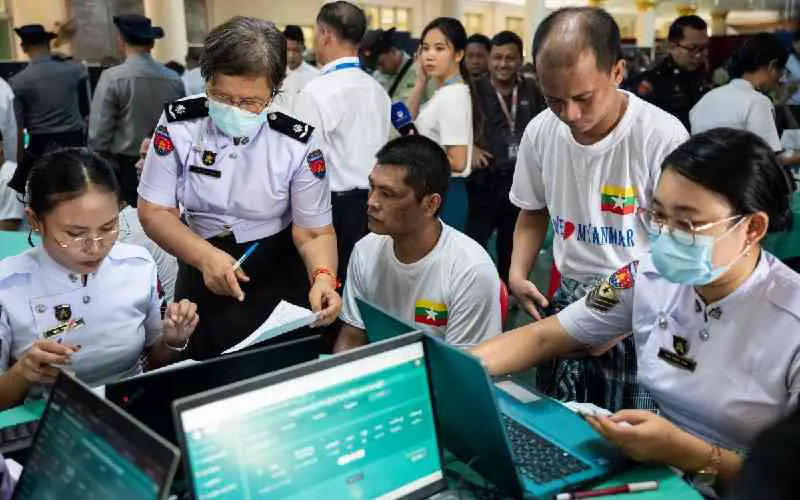
Nearly 1,500 Myanmar migrants from Malaysia were returned to their war-torn home country on Sunday, October 4, 2026, under an opaque repatriation scheme. The returnees, mostly men, as well as 27 children and 79 women, arrived by Myanmar Navy ships that docked at the nearby base in Thanlyin. Dozens of migrants were transported on buses to a Buddhist monastery hall for immigration and health checks.
The United Nations has warned that conditions in Myanmar, which has been consumed by civil war since a 2021 military coup, mean safe homecomings cannot be guaranteed as required under international law. The UN refugee agency said its staff were not allowed to meet migrants to confirm whether their decisions to return "were genuinely free and informed".
Malaysia insists all returnees agreed to voluntary repatriation from detention centres, but the UN and rights groups have raised concerns that Myanmar migrants had little choice. Monitor organisations such as Fortify Rights report dire conditions in the detention centres. Yap Lay Sheng, a senior human rights specialist with Fortify Rights, expressed concerns about the treatment of returnees.
Hundreds of families with vehicles gathered at dawn to collect their relatives outside the naval base, some holding up paper signs with photographs or the names of their loved ones. However, a naval official dashed hopes of immediate reunions for most, saying returnees would first be brought to different locations in the Yangon region.
One of the returnees, Kyaw Swar Thein, 53, who worked in a coffee shop in Malaysia before he was arrested, expressed uncertainty about his future. He said he suffered scabies while in detention for a year and eight months, which was one reason he wanted to come home. Another returnee, Kyaw Myint, 55, worried that his three grandchildren, who were detained in Malaysia for more than a year, could now be conscripted in Myanmar.
The Malaysian Prime Minister, Anwar Ibrahim, announced the repatriations in July against a backdrop of rising xenophobia towards refugees, particularly the Rohingya. There are concerns that members of the persecuted Rohingya are among the returned group. Myanmar's Min Aung Hlaing, the coup leader who was installed as civilian president in April, is expected to visit Malaysia soon to discuss the repatriation scheme.
Myanmar pledged that returns will be "safe and dignified", but the UN rights chief Volker Turk said on Tuesday that "this is no time to return anyone forcibly to a country plagued by egregious human rights violations and abuses". The ships left Malaysia on Tuesday carrying 1,476 migrants, according to the Myanmar government -- the first of 5,000 that Malaysian Prime Minister Anwar Ibrahim says Myanmar agreed to take back.
Key points
- The repatriation scheme has raised concerns about the safety of returnees.
- The United Nations has warned that conditions in Myanmar mean safe homecomings cannot be guaranteed.
- Malaysia is moving ahead with plans to return a second group of more than 3,500 migrants.