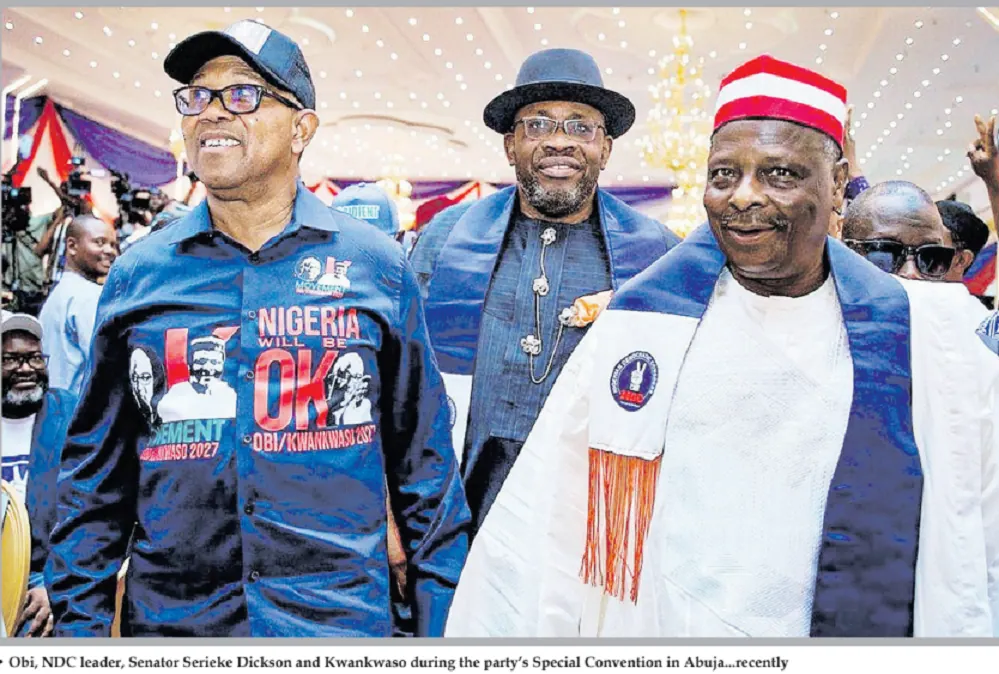
The Nigerian Democratic Congress (NDC) has formed an opposition alliance with Peter Obi, former Anambra State governor, as its presidential candidate, and Rabiu Kwankwaso, former Kano State governor, as his running mate. This alliance brings together two influential politicians with substantial followings in different parts of Nigeria. However, beneath their formal unity, the Obi-Kwankwaso ticket faces challenges due to competing political interests, policy differences, and support structures.
One of the clearest examples of these challenges is the controversy over fuel subsidy. Obi has consistently maintained that subsidy should be removed, criticizing its implementation and management. In contrast, Kwankwaso suggested introducing subsidy "in our own way" and emphasized the importance of domestic refining capacity to reduce petrol prices. This led to questions about whether the two men were presenting different economic prescriptions to voters.
Obi later clarified that there was no disagreement between him and Kwankwaso, explaining that his running mate was proposing a different approach rather than a return to the old subsidy regime. This episode highlights the challenge of presenting a common policy platform when two politicians with distinct histories and positions share the same ticket.
Another issue shaping the alliance is the question of power rotation. Kwankwaso disclosed that he and Obi had signed agreements under which Obi would serve only one four-year term if elected in 2027, after which the presidency would return to the North. This arrangement establishes an understanding on northern succession and represents a commitment to a single-term presidency for Obi.
The NDC's formal structure is also at odds with the movements supporting its presidential ticket. The Obidient and Kwankwasiyya movements have pre-existing identities and networks that raise questions about coexistence with established party structures. This tension became public in September when the NDC disowned a Presidential Campaign Council announced by the OK Movement, describing it as unauthorized.
The party subsequently gave Obi and Kwankwaso the authority to nominate key officials of its official Presidential Campaign Council in consultation with the leadership. This development exposed a basic question: who controls the machinery of the 2027 campaign — the party, the candidates, or the movements around them?
The NDC's established leadership, including Senator Henry Seriake Dickson, played a central role in bringing Obi and Kwankwaso into the party. However, their arrival has altered the party's internal balance, leading to signs of resistance to that adjustment. The party must now integrate these groups into a single campaign structure without allowing any of them to become a competing centre of authority.
Key points
- The NDC's Obi-Kwankwaso ticket faces challenges due to competing political interests, policy differences, and support structures.
- The alliance must reconcile internal tensions and power struggles to present a united front in the 2027 presidential election.
- The party's leadership must balance the influence of established leaders with the weight that Obi and Kwankwaso bring to the party.