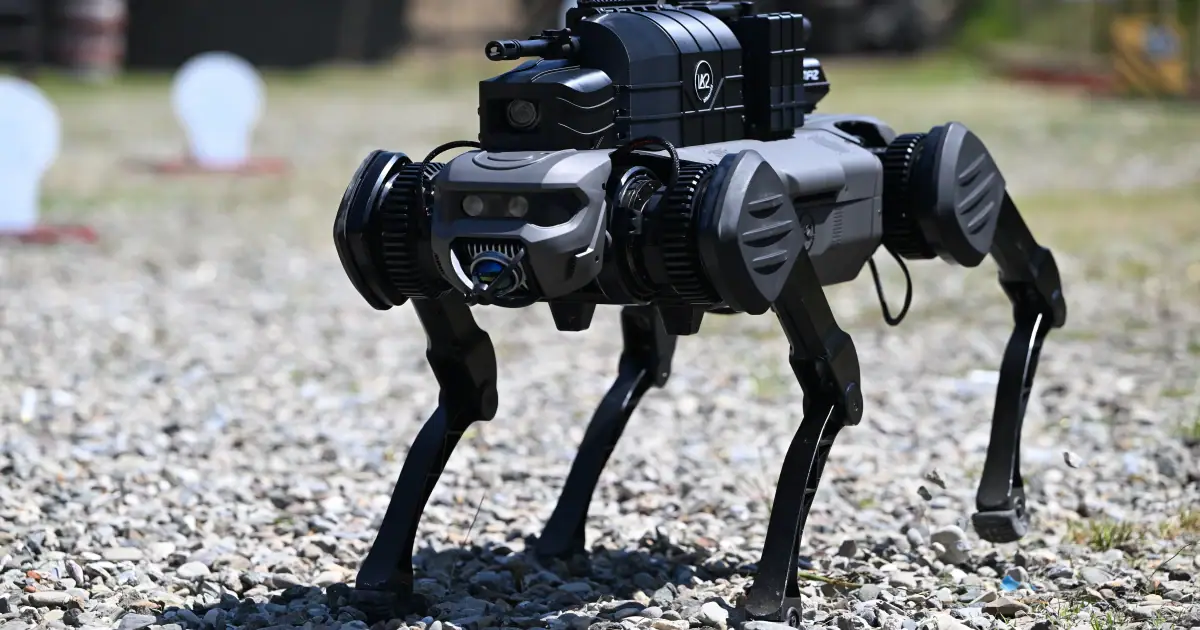
Efforts to set firm rules on AI-powered killer robots and drones have stalled as U.N.-backed talks in Geneva produced a softened agreement to extend discussions for two more years. The week-long U.N. conference on weapons concluded with scores of countries agreeing to "elaborate" a possible accord on lethal autonomous weapons systems by 2028. However, they did not commit to binding rules sought by U.N. Secretary-General António Guterres and many countries.
The outcome of the talks highlights the difficulty of achieving concrete results in diplomacy amid global conflicts and major military powers jockeying for dominance. Izumi Nakamitsu, the U.N. high representative for disarmament affairs, hailed a "significant achievement" but acknowledged a "glass half full or half empty" scenario. This is due to Guterres' hopes for a legally binding deal this year, which were not met.
Activists have accused military powers like Russia and the United States of blocking stronger language. Stop Killer Robots lamented a "watered-down mandate," and Beatrice Fihn, founder of international law advocacy group Lex International, said the decision amounts to "pushing the can down the road for two more years." They noted that most countries supported work toward a new treaty.
Before the meeting, seven countries proposed launching negotiations on a rulebook that could prevent or limit the ability of machines to kill without human control or accountability. However, this effort fell short. Ambassador Frederico Meyer of Brazil, which joined Austria, Belgium, Ireland, Mexico, New Zealand, and Panama in proposing such negotiations, said "Technology is moving faster than diplomacy."
Diplomats have been discussing the issue for years, with advocacy groups bemoaning obstructionism largely by Russia, which, like other top AI weapons-developing countries such as the United States, wants a freer hand to develop such high-tech weapons. Guterres set a 2026 deadline for launching negotiations toward an agreement on autonomous weapons systems.
The issue has been framed as an existential debate by Pope Leo XIV and many advocacy and humanitarian groups, urging quick action to rein in AI weapons before they become too commonplace to regulate easily. Activists say armed drones that can independently strike targets have already been deployed in some select instances in conflict zones.
The talks centered on the Convention on Certain Conventional Weapons, ratified by 128 countries, where decisions are made by consensus. This means any single country can thwart an agreement, and any deal is likely to be based on a low common denominator. Max Tegmark, a machine learning specialist at the Massachusetts Institute of Technology, said states have agreed it is sufficient to just talk about the issue for the 14th year.
Key points
- The UN-backed talks agree to extend discussions on AI-powered killer robots for two more years without a firm commitment to rein them in.
- Activists accuse military powers like Russia and the US of blocking stronger language on regulating AI-powered killer robots.
- The outcome highlights the difficulty of achieving concrete results in diplomacy amid global conflicts and major military powers jockeying for dominance.