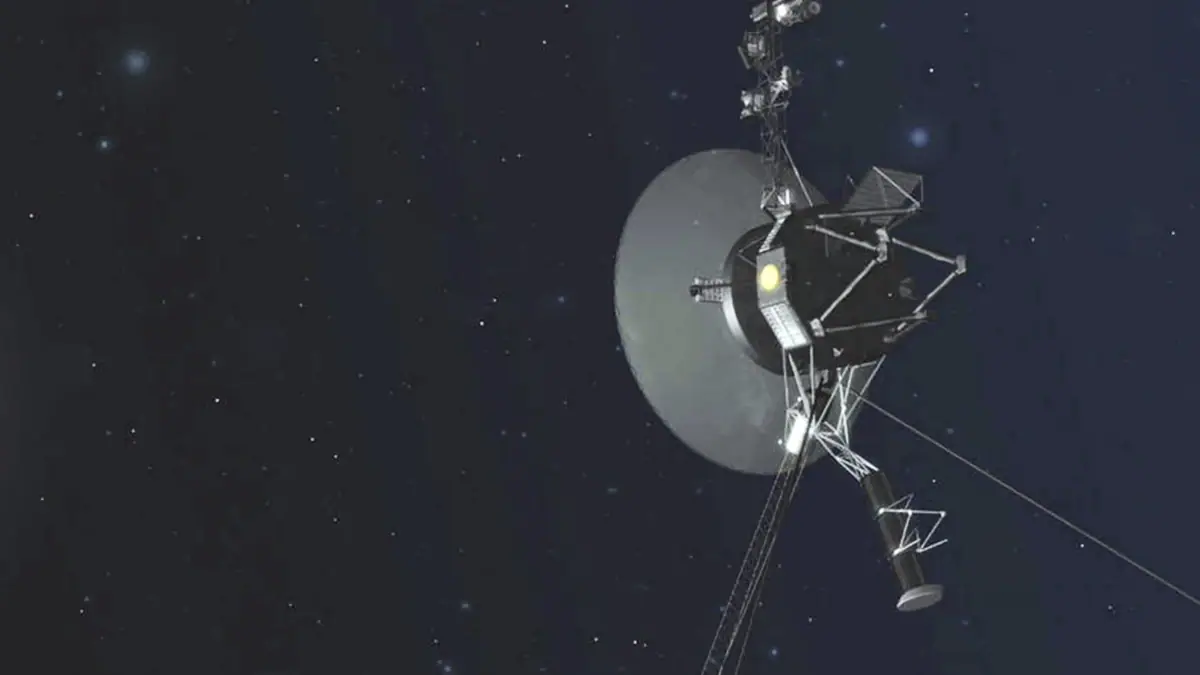
NASA's Voyager 1 spacecraft has traveled farther than any other human-made object in space, and on Wednesday, it reached a new milestone: a distance of one-light day away from Earth. This achievement marks a significant event in the spacecraft's nearly 50-year journey, which began on September 5, 1977. Voyager 1 has been conducting flybys of Jupiter and Saturn, and has been exploring the interstellar boundary since 2012.
To celebrate this occasion, NASA is hosting a symbolic celebration called "Shine Bright for Voyager's Light-Day." The public is invited to send Voyager's call sign, V-G-R, into the sky in morse code using a flashlight, phone light, or any other device that can blink a sequence. The morse code sequence is as follows: V - Three quick flashes, one long flash; G - Two long flashes, one quick flash; R - One quick flash, one long flash, one quick flash.
A light-day is the distance light travels in 24 hours, which is approximately 16 billion miles. Voyager 1 has been traveling for 49 years, two months, and 11 days, and is estimated to reach "light-day status" at 5:16 a.m. ET on Wednesday. The spacecraft has been powered by a radioisotope thermoelectric generator, which is expected to keep it operational until around 2025.
Voyager 1 has made significant contributions to our understanding of the outer Solar System and beyond. In 1979, it discovered a faint ring system on Jupiter, and in 1980, it took detailed photos of Saturn's rings and moons. On February 17, 1998, Voyager 1 overtook the U.S. space probe, Pioneer 10, becoming the most distant human-made object in existence.
Voyager 1 and its twin, Voyager 2, are the only spacecraft to have operated outside of the heliosphere, which acts as a protective shield for the Solar System. The spacecraft has been exploring the interstellar boundary, charting and measuring magnetic fields, particles, and plasma waves outside the sun's heliosphere and the atmosphere of other stars.
Earlier this year, NASA elected to shut off Voyager 1's Low-energy Charged Particles experiment, or LECP, in order to save power. This decision was made to keep the probe alive longer, as it continues to explore the interstellar medium. Voyager 1 has two science instruments still running: one that measures magnetic fields and another that listens for plasma waves.
The Voyager spacecraft is carrying the Golden Record, an interstellar "time capsule" that contains 115 images, natural sounds, and spoken greetings in 35 different languages. The record also includes instructions on how to play it and the origin of the probe. Voyager 1's journey continues to provide valuable insights into the outer reaches of our Solar System and beyond.
Key points
- Voyager 1 has traveled over 16 billion miles and has been in operation for nearly 50 years.
- The spacecraft has entered interstellar space and is exploring the magnetic fields, particles, and plasma waves outside the sun's heliosphere.
- NASA is celebrating this milestone with a public event, "Shine Bright for Voyager's Light-Day," where people can send Voyager's call sign into the sky in morse code.