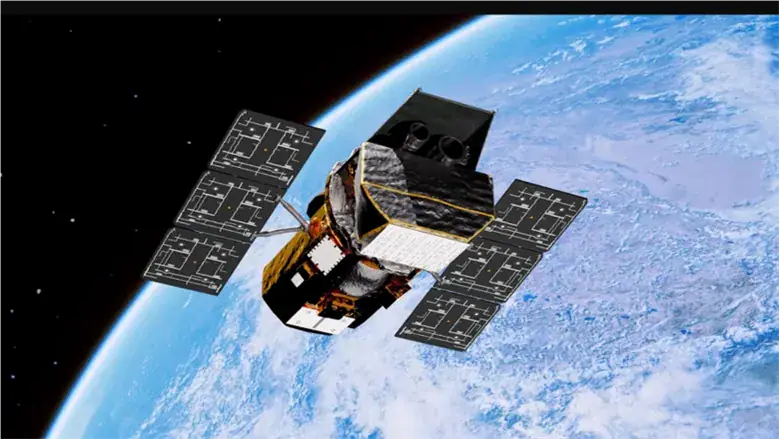
The Swift space telescope, a prominent NASA spacecraft, has ended its 22-year mission to study the universe's most powerful explosions. The spacecraft re-entered Earth's atmosphere on Wednesday, near Indonesia, as predicted by the US Space Force. This event marked the conclusion of a mission that far exceeded its initial two-year planned duration. Swift was launched in 2004 to study gamma-ray bursts and supernovae.
The spacecraft played a crucial role as a first responder to these cosmic events, enabling other telescopes to conduct in-depth studies. Over its extended mission, Swift detected thousands of gamma-ray bursts, significantly advancing scientific understanding of these phenomena. Its longevity and contributions have made it a valuable asset in the field of astrophysics. Swift's impact on the scientific community will be remembered for years to come.
Prior to its re-entry, NASA had attempted a rescue mission to revive Swift. The agency partnered with a private company to develop a robotic spacecraft designed to boost Swift to a higher orbit. However, the mission encountered difficulties, and the robotic spacecraft ultimately failed to accomplish its objectives. Despite this, NASA continued to monitor Swift's orbit and predict its re-entry point.
The 1.5-ton spacecraft faced intense heat as it pierced the Earth's atmosphere, with some parts expected to survive the intense friction. Although the exact extent of the damage was not immediately clear, NASA had prepared for the possibility of debris falling to Earth. The agency's tracking efforts ensured that the re-entry was safely predicted and monitored.
Swift was initially designed to operate for two years, but it continued to function for 11 times its planned duration. During its extended mission, the spacecraft contributed significantly to the understanding of cosmic explosions. Its ability to quickly respond to gamma-ray bursts allowed other telescopes to conduct follow-up studies, greatly enhancing the scientific return of these events.
The loss of Swift marks the end of an era in space-based astronomy. However, its legacy will continue through the data it collected and the scientific discoveries it enabled. The knowledge gained from Swift's mission will inform future space-based observatories, ensuring that the study of cosmic explosions remains a vibrant area of research.
As the scientific community reflects on Swift's achievements, it also looks forward to future missions that will build upon its discoveries. The experience gained from operating Swift will inform the development of new spacecraft, enabling scientists to continue exploring the universe and uncovering its secrets. The impact of Swift's mission will be felt for years to come.
Key points
- NASA's Swift space telescope completed a 22-year mission to study cosmic explosions.
- The spacecraft re-entered Earth's atmosphere near Indonesia, marking the end of its operational life.
- Swift far exceeded its planned two-year duration, detecting thousands of gamma-ray bursts and advancing scientific understanding of these phenomena.