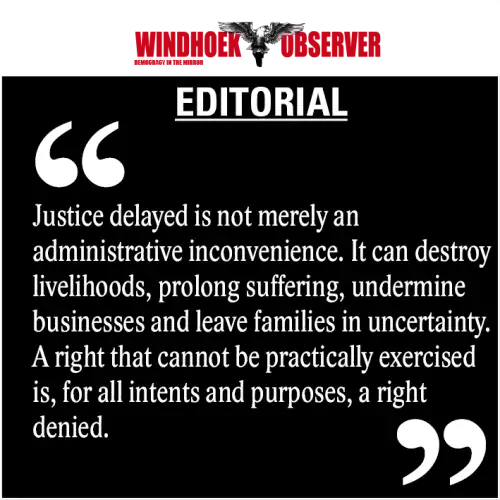
Namibian Minister of Justice and Labour Relations Fillemon Wise Immanuel has stressed that democracy means little if ordinary citizens cannot access justice. He warned that democracy risks becoming an empty promise when citizens cannot exercise their rights. This challenge is crucial for Namibia, where the Constitution guarantees equality before the law, human dignity, freedom, and fundamental rights. These guarantees must translate into tangible improvements in everyday life for ordinary Namibians.
Many Namibians face significant barriers to accessing justice, including the high cost of legal representation, lengthy court processes, geographical barriers, and inadequate access to legal assistance. Cases often drag on for years, and legal costs remain prohibitive. People in rural communities face additional obstacles in accessing justice services. Minister Immanuel's call for people-centred justice must lead to measurable institutional reform, going beyond conference speeches and declarations of intent.
The performance of Namibia's justice system should be measured by how efficiently disputes are resolved, how fairly citizens are treated, and whether people have confidence that the law applies equally to everyone. The minister's observation that justice must not depend on socio-economic status or who one knows deserves particular attention. Perceptions that wealth, influence, or political connections can determine outcomes are corrosive to public confidence.
To address these challenges, the government must confront practical shortcomings within the justice system. Court backlogs must be reduced through better case management, adequate judicial capacity, and effective technology use. Legal aid must be strengthened so that indigent citizens are not denied representation due to financial constraints. Justice services must become more accessible to rural communities.
The police, prosecution services, correctional facilities, judiciary, and Ministry of Justice must operate as a coordinated system. Inefficiency at one point in the chain compromises the entire process. Reforms must be accompanied by measurable targets, transparent reporting, and regular assessments of institutional performance. Citizens deserve to know whether court backlogs are declining, cases are being finalised faster, and access to legal assistance is improving.
A well-functioning justice system also has economic benefits. Investors, entrepreneurs, and businesses require predictable laws, independent institutions, and efficient dispute-resolution mechanisms. A justice system that commands public confidence strengthens economic participation, protects property rights, and creates an environment conducive to investment and enterprise.
Minister Immanuel's emphasis on cooperation between Namibia and South Africa is also relevant. However, bilateral agreements and regional commitments will only have meaning if they produce practical benefits for citizens. Ultimately, a democracy is only as strong as the confidence its citizens have in its institutions, which is earned through fairness, efficiency, transparency, and accountability.
Key points
- Namibian Justice Minister Fillemon Wise Immanuel calls for people-centred justice system reform.
Reporting sources
- Justice must be experienced, not merely promised · Windhoek Observer