President Netumbo Nandi-Ndaitwah's recent visit to Moscow for the Russia-Africa Summit highlights the enduring political relationship between Namibia and Russia, forged during Namibia's liberation struggle when the Soviet Union provided significant support. This history is crucial and should not be forgotten. However, Namibia now seeks to leverage this relationship to boost its economy. The President's presence at the summit presents an opportunity for Namibia to inquire about converting its political friendship with Russia into a more substantial economic partnership that benefits Namibians.
According to the Institute for Public Policy Research's Namibia Quarterly Economic Review, Namibia's exports to Russia were valued at N$65.3 million in 2025, down from N$100.1 million in 2024. Russia accounted for a mere 0.07 percent of Namibia's total goods exports, ranking 33rd among the country's export destinations. This is remarkably low for a country with which Namibia enjoys longstanding political ties. The narrow composition of Namibia's exports to Russia is also concerning, with crustaceans and fruit and nuts making up almost 96 percent of the total.
On the other side of the trade equation, Namibia imported N$791.8 million worth of goods from Russia in 2025, up from N$480 million in 2024. Wheat and fertilisers accounted for more than 97 percent of imports from Russia. While there is nothing inherently wrong with this imbalance, it exposes a wider weakness in the economic relationship between the two countries. For Namibia, access to wheat and fertiliser is crucial, particularly in the context of food security and agricultural production.
The shallow and highly concentrated economic relationship between Namibia and Russia presents an opportunity for growth. Namibia is entering a period where it needs substantial capital, markets, technology, and expertise to develop its oil and gas resources, expand green hydrogen, grow its mining industry, strengthen agriculture, improve infrastructure, and diversify tourism. Russia, like other major economic powers, should be asked what it can contribute to these ambitions.
The proposed Rosatom uranium project near Leonardville demonstrates the potential benefits of Russian investment, including capital, employment, infrastructure, skills, and revenue. However, concerns surrounding the Stampriet Aquifer must be taken seriously, given Namibia's water security challenges. Any development that could affect an important underground water resource must be subjected to rigorous scientific assessment and transparent regulatory processes.
There are also opportunities in tourism, with Russian tourist arrivals increasing from 3,501 in 2024 to 8,727 in 2025. While still a relatively small market, the growth suggests potential. Namibia's extraordinary landscapes, wildlife, and tourism infrastructure could appeal to a much larger Russian market if connectivity, marketing, and travel arrangements are properly developed.
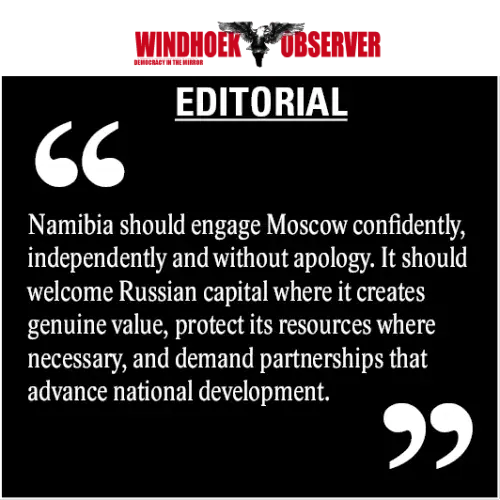
To achieve tangible benefits, Namibia needs concrete agreements, investment commitments, market access, and partnerships that can be measured. The country has had decades of political solidarity with Russia, but what it needs now is a new generation of economic solidarity. This requires identifying specific sectors where Russian capabilities and capital can complement Namibian opportunities.
Key points
- Namibia seeks to convert its longstanding political friendship with Russia into a stronger economic partnership.
- The current economic relationship between Namibia and Russia is shallow and highly concentrated.
- Namibia needs concrete agreements and investment commitments from Russia to achieve tangible economic benefits.