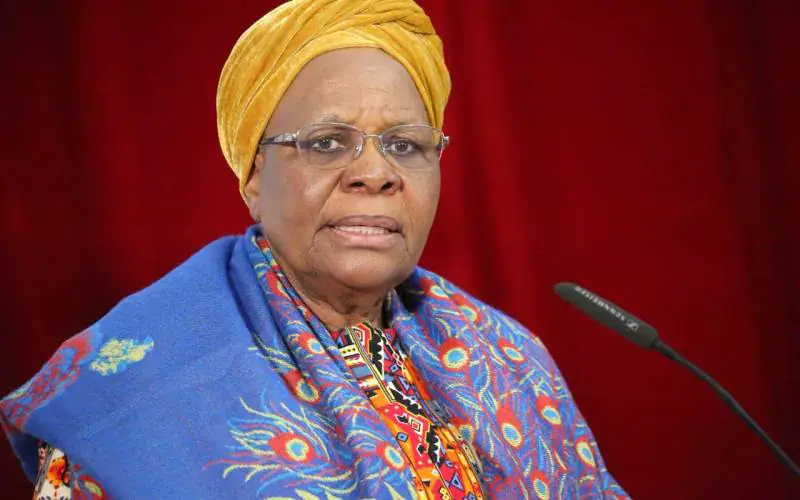
President Netumbo Nandi-Ndaitwah has urged government institutions to avoid frustrating investors through unnecessary bureaucratic delays and administrative inefficiencies. She emphasized the importance of creating an environment in which businesses can operate with confidence. Nandi-Ndaitwah made these remarks at the Third National Nuclear Science and Technology Conference in Swakopmund, read on her behalf by Prime Minister Elijah Ngurare.
Nandi-Ndaitwah's warning comes after her admission that government bureaucracy nearly cost Namibia a multibillion-dollar investment by Nigerian businessman Aliko Dangote. She had to personally contact Dangote to plead with him to hold on and make the investment work. A proposed shipyard investment in the Erongo region was abandoned after four years of delays, influencing her decision to intervene in the Dangote project.
Namibia is seeking to attract investment into its nuclear industry and expand its role beyond uranium extraction and exports. Nandi-Ndaitwah stated that the country must secure a greater share of the economic benefits from its natural resources and participate in more stages of the nuclear industry's value chain. She emphasized that Namibia should take its rightful place on the world stage in the value chains of the nuclear industry.
The country is the world's third-largest uranium producer in 2024, after Kazakhstan and Canada, according to the World Nuclear Association. The government is seeking partnerships in areas including uranium conversion, nuclear power generation, medical radioisotope production, and radioanalytical capabilities. Local businesses and entrepreneurs must also have opportunities to participate in these developments.
Nandi-Ndaitwah highlighted Namibia's dependence on imported electricity, stating that the country imported between 40% and 65% of its electricity over the past year. She declared that this must no longer be the norm and that Namibia must forge a path to become a net exporter of power. The government has commissioned a roadmap for a national nuclear power programme and established a Nuclear Energy Programme Implementing Organisation.
The government is examining advanced reactor technologies, including small modular reactors and microreactors, which could generate electricity and support industries such as desalination, green hydrogen, steel, and chemical manufacturing. Chairperson of the Parliamentary Standing Committee on Natural Resources Toby Aupindi emphasized the need for Namibia to use scientific knowledge and technology to turn its natural resources into wider economic opportunities.
Aupindi called for a national roadmap covering nuclear medicine, research, uranium value addition, radiation technologies, and specialised engineering. He also emphasized the importance of international partnerships that include skills transfer, training, research facilities, and opportunities for Namibian businesses. Nandi-Ndaitwah added that nuclear science has applications in healthcare, agriculture, water management, food security, and industry, including cancer diagnosis and treatment, food safety, and groundwater mapping.
Key points
- President Nandi-Ndaitwah warns against frustrating investors through bureaucratic delays and administrative inefficiencies.
- Namibia seeks to attract investment into its nuclear industry and expand its role beyond uranium extraction and exports.
- The country aims to become a net exporter of power and reduce its reliance on imported electricity.
Reporting sources
- NNN warns against frustrating investors, importing electricity · Windhoek Observer