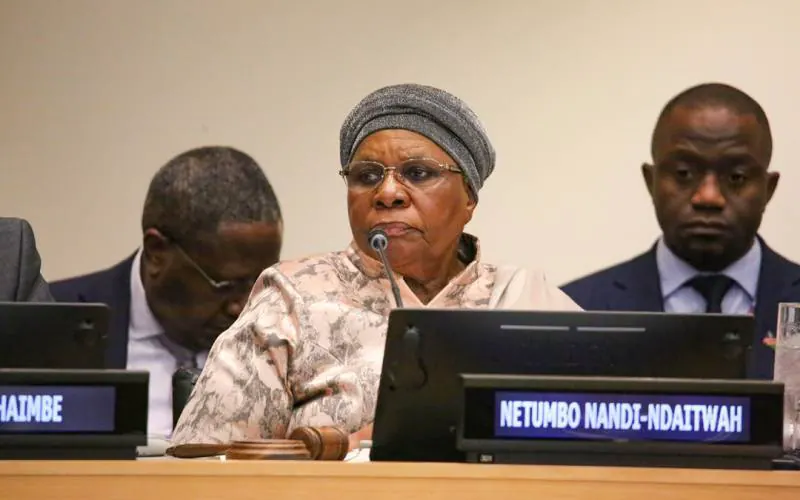
President Netumbo Nandi-Ndaitwah of Namibia has emphasized the need for a stronger African voice in shaping the global financial system. Speaking at a high-level side event on the implementation of the Pact for the Future in Africa, held on the margins of the 81st session of the United Nations General Assembly in New York, she stressed that African countries must have a greater say in decisions affecting their development. This call for reform is crucial for the continent's growth and progress.
Nandi-Ndaitwah highlighted the challenges posed by illicit financial flows, which remain a significant obstacle for Namibia and the African continent as a whole. She emphasized that a collective and stronger African voice is necessary to accelerate the reform of the international financial architecture. This would enable African countries to take greater ownership of their development and push for changes that benefit the continent. The President's remarks underscore the importance of African representation in global financial decision-making.
The Namibian President also advocated for full African participation in negotiations towards a United Nations Framework Convention on International Tax Cooperation. She believes that Africa needs a fair and effective international tax system to achieve sustainable development. Nandi-Ndaitwah noted that while Namibia is strengthening its domestic resource mobilization through improved tax governance structures under its Sixth National Development Plan, national efforts must be complemented by reforms to the international financial system.
Nandi-Ndaitwah pointed out that African countries played a key role in the adoption of the Pact for the Future and its two annexes, the Global Digital Compact and the Declaration on Future Generations. Namibia co-facilitated the negotiations that led to the pact's adoption alongside Germany. The agreement offers an opportunity for Africa to advance its development priorities while accelerating the implementation of the Sustainable Development Goals. This achievement demonstrates Africa's commitment to global cooperation and development.
The President highlighted the significant convergence between the Sustainable Development Goals and the African Union's Agenda 2063, particularly in areas such as peace, sustainability, inclusive growth, and digital transformation. With over 90% convergence, the two frameworks share common objectives that can be achieved through collaborative efforts. Nandi-Ndaitwah also mentioned Namibia's National Digital Strategy 2025–2028, which aims to leverage technology and innovation to drive development and inclusive growth.
The National Digital Strategy includes measures to enhance cybersecurity and digital trust, emerging technologies like artificial intelligence, and the participation of women and youth in the digital economy. On youth development, Nandi-Ndaitwah referenced Namibia's free tertiary education policy, which covers tuition and registration fees, and the National Youth Fund, established to support young entrepreneurs and address youth unemployment. These initiatives demonstrate Namibia's commitment to empowering its youth and driving economic growth.
Nandi-Ndaitwah emphasized that African governments must take responsibility for translating development commitments into tangible improvements for their citizens. She stressed that citizens expect their leaders to make effective and bold decisions for their prosperity and advancement. The Pact for the Future provides African countries with additional tools to pursue their development priorities, and Nandi-Ndaitwah expressed optimism that it will help achieve Africa's noble aspirations.
Key points
- Namibia's President Netumbo Nandi-Ndaitwah calls for a stronger African voice in global financial systems.
- African countries must take greater ownership of their development and push for reforms to the international financial architecture.
- The Pact for the Future offers African countries additional tools to pursue their development priorities and achieve the Sustainable Development Goals.