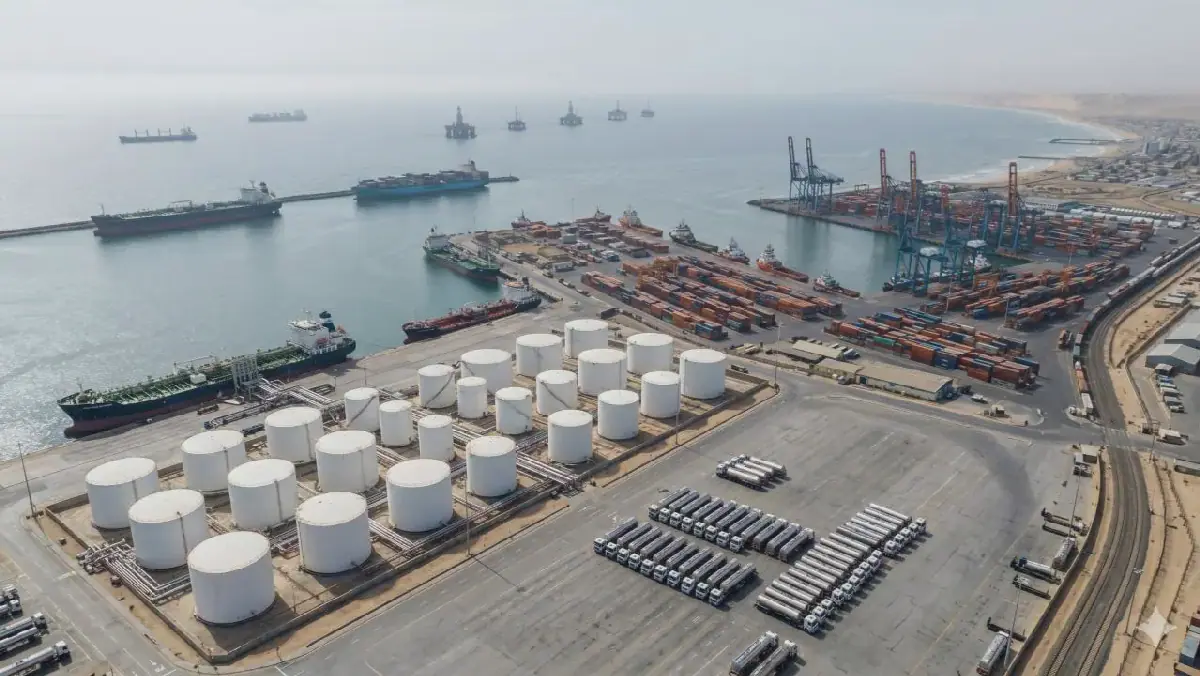
The Namibian government, in partnership with Nigerian industrialist Aliko Dangote, has launched a $2.5 billion fuel storage and regional pipeline project at Walvis Bay. The Dangote Namibia Tank Farm and Regional Pipeline Project aims to establish a major fuel storage facility with a planned capacity of approximately 600 million litres, equivalent to four million barrels. This development is expected to strengthen Namibia's petroleum distribution capacity and create a new supply corridor for neighbouring markets.
The proposed facility will include storage for 360 million litres of diesel and 240 million litres of petrol, alongside truck-loading, dispensing and associated distribution infrastructure. Construction is expected to be completed within 18 to 20 months. A major component of the investment is a proposed regional pipeline network extending approximately 1,700 kilometres, connecting Walvis Bay with inland distribution points and providing a supply route towards neighbouring markets, including Botswana, Zambia, Zimbabwe, Malawi and parts of the Democratic Republic of Congo.
The project offers opportunities beyond petroleum storage, supporting employment, logistics services, port operations and related businesses around Walvis Bay. It also aligns with Namibia's ambition to strengthen its position as a regional transport and logistics centre. The investment reflects the expanding regional ambitions of Dangote Industries Limited, which has continued exploring opportunities to strengthen energy infrastructure and fuel distribution across African markets.
For landlocked economies, access to reliable petroleum supply routes remains an important consideration for economic activity. Fuel is essential to transport, agriculture, manufacturing, mining and electricity generation. A regional storage and pipeline network could provide additional supply options, reduce dependence on long-distance road transportation for bulk fuel movements and improve distribution efficiency.
However, the project's potential will depend on effective implementation, including cooperation among several countries, environmental and regulatory approvals, and agreements on routes, cross-border operations, tariffs, supply arrangements and regulatory standards. Reporting by The Namibian on November 9 indicated that the Walvis Bay terminal was still awaiting environmental clearance, highlighting the distinction between the project's launch and the approvals required for full implementation.
The economic benefits will also depend on how effectively the facility connects with existing ports, transport operators and fuel distributors. While pipelines can improve the movement of bulk petroleum products, road transport will remain necessary to deliver fuel from distribution points to businesses, industrial users and filling stations. The project's success will depend on timely approvals, cross-border cooperation and the completion of the infrastructure required to make Walvis Bay a reliable distribution hub.
If delivered as proposed, the project could expand Namibia's logistics capacity while creating an additional energy corridor for neighbouring markets. The wider opportunity lies in ensuring that this investment translates into more reliable fuel supply, efficient distribution and sustainable economic benefits across Southern Africa. The project was launched on November 4, 2026, by President Netumbo Nandi-Ndaitwah and Aliko Dangote.
Key points
- The project aims to establish a major fuel storage facility with a planned capacity of approximately 600 million litres.
- The proposed regional pipeline network will extend approximately 1,700 kilometres.
- The project's success will depend on timely approvals, cross-border cooperation and the completion of the infrastructure required to make Walvis Bay a reliable distribution hub.
Reporting sources
- Namibia’s US$2.5 Billion Fuel Hub: Building a Strategic Energy Gateway for Southern Africa · African Leadership Magazine