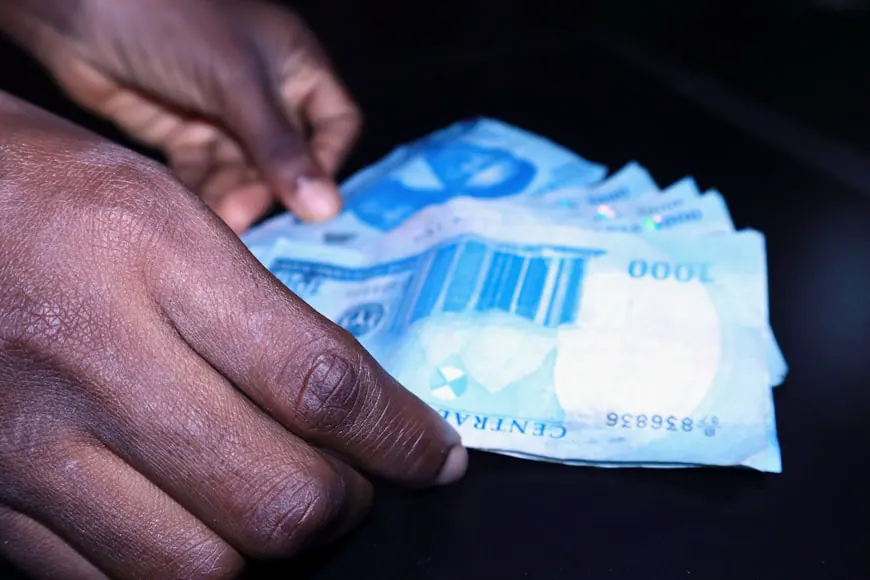
The naira concluded the week on a stable note across various foreign exchange market segments, following the Central Bank of Nigeria's decision to reset its benchmark interest rate. This stability is attributed to stronger external buffers that continue to support the local currency. According to data from the CBN, the naira appreciated marginally by N1.69 week-on-week, with the dollar quoted at N1,329.51 on Friday, compared to N1,331.20 the previous week.
On a day-on-day basis, the naira experienced a slight decline of 84 kobo from N1,328.67 on Thursday. However, over the five trading days, the naira strengthened marginally by 29 kobo from N1,329.80 on Monday. In the parallel market, also known as the black market, the naira steadied at N1,385 per dollar. The gap between the official and parallel market rates narrowed slightly to N56, or 4.21 percent, on Friday from N57, or 4.29 percent, on the previous day.
The foreign exchange market witnessed moderate activity during the week, with total turnover at the interbank segment standing at $711.79 million on Friday. This represents a decline from the cumulative turnover of $2.74 billion recorded over the five trading days of the previous week. For the four trading days of the current week, total turnover stood at $2.25 billion. The number of deals decreased to 1,351 in the four trading days this week, compared to 1,498 deals recorded over five trading days last week.
Nigeria's external reserves have continued to grow, reaching an 18-year high of $54.86 billion as of September 24, 2026. This represents a 30 percent increase from the $42.29 billion recorded in the corresponding period of 2025, according to data on the CBN website. Governor of the CBN, Olayemi Cardoso, stated that gross external reserves stood at $55.25 billion on September 18, 2026, sufficient to finance approximately 11.3 months of imports of goods and services.
The CBN's Monetary Policy Committee decided to reset the Monetary Policy Rate at 23 percent, recalibrate the Standing Facilities Corridor, and retain the Cash Reserve Requirement for Deposit Money Banks at 45 percent. Analysts noted that the rate cut could benefit equities and the wider economy but also poses risks for portfolio flows and the foreign-exchange market. Muda Yusuf, CEO of the Centre for the Promotion of Private Enterprise, highlighted the potential risks of portfolio-flow reversals and renewed pressure on the foreign-exchange market.
Despite potential risks, Nigeria's stronger external buffers, improved foreign reserves, and greater stability in the foreign-exchange market have mitigated the impact of the rate cut. The CPPE noted that these factors have improved the country's resilience to monetary policy changes. The divergent monetary policy directions between Nigeria and other major central banks could affect interest-rate differentials and the attractiveness of naira-denominated financial assets.
The implications of the rate cut and its impact on the economy will be closely monitored. The stability of the naira and the growth of external reserves are critical factors in maintaining investor confidence. As the economic landscape evolves, stakeholders will be watching the CBN's policy decisions and their effects on the foreign-exchange market and overall economic stability.
Key points
- The naira appreciated marginally by N1.69 week-on-week.
- Nigeria's external reserves reached an 18-year high of $54.86 billion.
- The CBN reset the Monetary Policy Rate at 23 percent.