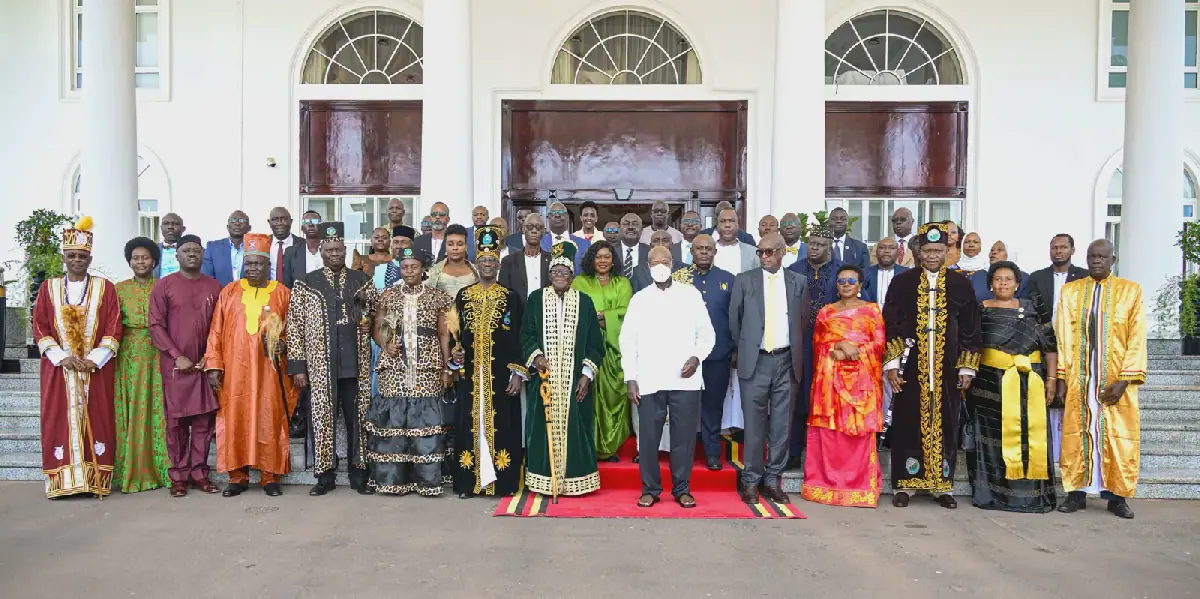
On November 5, 2026, President Yoweri Kaguta Museveni addressed a two-day conference of traditional and cultural leaders at State House, Entebbe. He emphasized that cultural institutions must respect the constitutional responsibilities of elected government structures and focus on preserving African heritage, promoting wealth creation, and guiding communities. Museveni urged traditional leaders to concentrate on their distinct responsibilities, which should not be confused with those of political leaders.
According to Museveni, cultural institutions can contribute to national development by mobilizing communities for wealth creation, preserving traditional skills, and promoting social cohesion. He identified agriculture, livestock keeping, and fishing as areas where traditional skills can be preserved and passed on to younger generations. The President also called on cultural leaders to protect Africa's historical identity, languages, and customs, which have been affected by colonialism.
Museveni outlined five historical missions that should guide Africa's development: liberation from colonialism, democracy, economic prosperity, strategic security, and African unity. He argued that political independence must be supported by economic development and access to larger markets. The President cited the East African Community, COMESA, and the African Continental Free Trade Area as important arrangements for expanding trade and economic cooperation.
During the conference, cultural leaders proposed stronger partnerships with the government in agriculture, community industrialization, tourism, skills development, and women's economic empowerment. They offered to provide land for model agricultural farms and requested government support through improved seeds, livestock, irrigation equipment, and agricultural machinery. The leaders also proposed establishing community-based processing facilities for agricultural products and textiles.
The cultural leaders also emphasized the importance of preserving Uganda's cultural heritage. They called for the establishment of a Digital Cultural Park to document Uganda's kingdoms, chiefdoms, historical sites, artifacts, and indigenous knowledge. Additionally, they announced plans to organize a Uganda National Cultural Festival in partnership with the Ministry of Gender, Labour, and Social Development to promote Uganda's cultural diversity and support tourism.
The Minister of Gender, Labour, and Social Development, Gen. Henry Tumukunde, urged traditional leaders to work with the government in addressing social issues such as gender-based violence, child marriage, and poverty. He also encouraged cultural institutions to support Uganda's creative economy, particularly music, film, fashion, and cultural tourism. The two-day conference brought together traditional and cultural leaders from across Uganda to discuss their role in cultural preservation and national economic transformation.
The conference concluded with a call for greater collaboration between cultural leaders and the government. The leaders appealed for government assistance to strengthen the Forum of Cultural Institutions, citing inadequate staffing, limited infrastructure, and poor coordination among their challenges. Key points from the conference include the need for cultural leaders to focus on preserving African heritage, promoting wealth creation, and guiding communities, while leaving legislation and public administration to constitutional institutions.
Key points
- Cultural leaders should focus on preserving African heritage and promoting wealth creation.
- The government and cultural leaders should collaborate on agriculture, community industrialization, and tourism.
- A Digital Cultural Park should be established to document Uganda's cultural heritage.