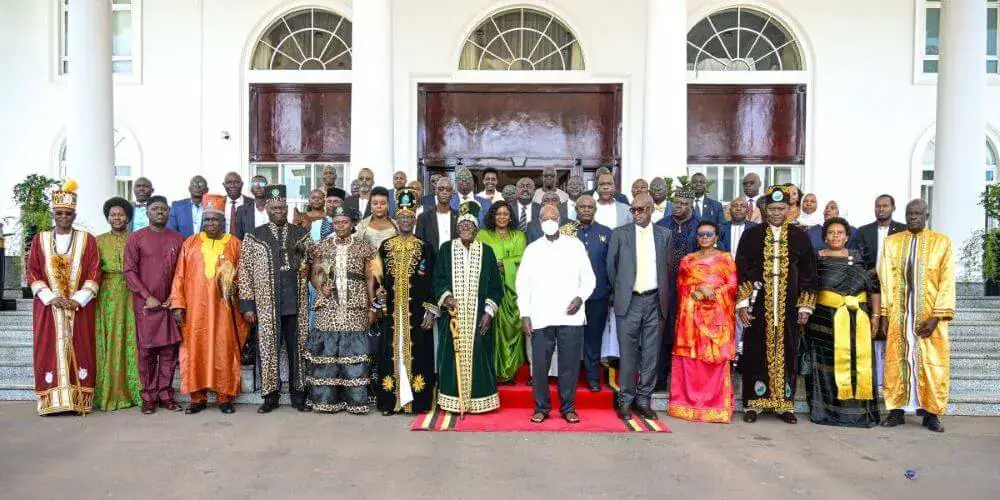
President Yoweri Museveni of Uganda has advised cultural leaders to refrain from engaging in politics and instead focus on preserving cultural heritage, promoting indigenous knowledge, and guiding their communities. He made these remarks at a two-day Cultural Leaders Conference at State House, Entebbe, where kings and other cultural leaders from across Uganda had gathered. Museveni emphasized that traditional leaders should not assume political responsibilities, as they are not directly accountable to voters.
Museveni argued that elected leaders, unlike traditional leaders, are accountable to the people and can be removed from office if they fail to perform. He questioned how citizens could hold traditional leaders accountable if they ventured into political responsibilities, given that their positions are determined by birth. The President compared the relationship between cultural leaders and their subjects to that between parents and their grown-up children, suggesting that traditional leaders should offer guidance when requested rather than attempting to run people's affairs.
The President also revisited the political disagreements that led to the abolition of kingdoms in 1967 under former President Milton Obote. Museveni expressed disagreement with Obote's approach, accusing him of initially appearing to support federalism before abandoning the arrangement and using force to abolish the kingdoms without consultations. In contrast, Museveni praised former Democratic Party leader Benedicto Kiwanuka for openly explaining the proposed political arrangements to the kingdoms.
Museveni emphasized that cultural institutions should relinquish responsibilities such as policy formulation, legislation, administration, and adjudication to avoid conflicts with the country's political and judicial structures. However, he noted that traditional institutions have an important role in preserving Uganda's cultural identity and indigenous knowledge, which should contribute to national development. He urged cultural leaders to promote skills such as agriculture, livestock keeping, and crafts.
The President called for patriotism and Pan-Africanism, arguing that tribal chauvinism and lack of integration have weakened indigenous societies. He encouraged cultural leaders to promote unity and economic prosperity while leaving politics and administration to elected leaders. Museveni also stressed the importance of preserving indigenous languages, traditions, and knowledge for future generations.
During the conference, cultural leaders proposed partnerships with the government in areas such as agriculture, community industrialization, tourism, skills development, and women's economic empowerment. They offered to provide land for model agricultural farms, provided the government supports the initiatives with improved seeds, livestock, and agricultural extension services. The leaders also proposed the establishment of a Digital Cultural Park to document and showcase Uganda's cultural heritage.
The conference aimed to provide a framework for cooperation between cultural institutions and the government on heritage preservation, community development, and national integration. The President's message to cultural leaders was clear: they should focus on preserving cultural heritage and guiding their communities, rather than engaging in politics. The outcome of the conference is expected to promote unity, economic prosperity, and cultural preservation in Uganda.
Key points
- Cultural leaders should focus on preserving heritage and guiding communities, rather than engaging in politics.
- President Museveni emphasizes the importance of separating the responsibilities of cultural institutions from those of elected government and the judiciary.
- The conference aimed to promote cooperation between cultural institutions and the government on heritage preservation, community development, and national integration.