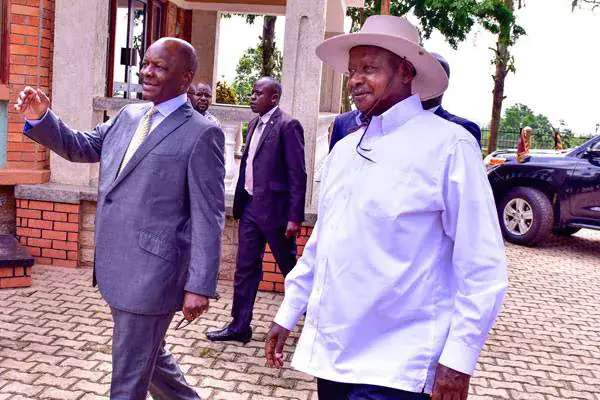
President Yoweri Kaguta Museveni has sparked fresh debate over Buganda Kingdom's historical legacy after dismissing parts of the kingdom's anthem as an expression of ignorance. He argued that its celebration of past military victories glorifies battles fought against neighboring communities. Museveni made these comments during the "Jazz with Jajja" sessions on Sunday. The President questioned the historical significance of the Buganda anthem, particularly its references to the kingdom's ancestors fighting and winning battles.
According to Museveni, the anthem presents an exaggerated picture of Buganda's historical greatness by celebrating military conquests that, in his view, did not represent any meaningful national achievement. He described the glorification of such victories as ignorance, suggesting that the kingdom was celebrating what he considered a questionable historical legacy rather than accomplishments that could genuinely inspire future generations. Museveni's remarks introduce another politically sensitive discussion about the interpretation of Buganda's history and cultural identity.
Buganda, one of Uganda's oldest and most influential traditional kingdoms, has a long history of territorial expansion, political influence, and military encounters with neighboring communities and kingdoms. Its historical institutions, royal traditions, and cultural symbols remain central to the identity of many Baganda, with the kingdom continuing to command significant cultural and political influence decades after the abolition and subsequent restoration of traditional institutions. The kingdom's anthem is among its important cultural symbols, expressing loyalty, pride, and historical identity among its subjects.
Museveni's criticism could attract reactions from cultural leaders, historians, and Buganda loyalists, particularly those who consider the anthem an important expression of their heritage rather than a literal celebration of warfare. The President's argument also raises questions about who determines which parts of Uganda's pre-colonial history deserve celebration and how historical military victories should be interpreted in contemporary society. His comments come against the backdrop of longstanding political and institutional tensions between the central government and Buganda Kingdom.
The comments have once again placed Buganda's history under the national spotlight, with the central question being whether its celebrated military victories should be regarded as symbols of greatness or, as Museveni suggests, simply battles against neighboring communities. For a kingdom whose cultural identity is deeply connected to its historical institutions and past achievements, the President's remarks are likely to generate considerable debate. This debate may lead to a re-examination of Buganda's history and its role in Uganda's national narrative.
The relationship between traditional institutions and the state is also likely to be scrutinized in light of Museveni's comments. The President's criticism of the Buganda anthem may be seen as an attempt to redefine the kingdom's cultural identity and its place in Uganda's national narrative. However, it remains to be seen how the kingdom's leaders and loyalists will respond to Museveni's remarks and whether they will lead to a significant shift in the way Buganda's history is interpreted and celebrated.
Ultimately, Museveni's comments highlight the complex and often contentious nature of Uganda's cultural and historical heritage. The debate over the Buganda anthem is likely to continue, with different stakeholders offering their perspectives on the kingdom's history and cultural identity. As the debate unfolds, it may lead to a deeper understanding of Uganda's complex cultural landscape and the role of traditional institutions in shaping the country's national narrative.
Key points
- President Museveni criticizes Buganda Kingdom's anthem as ignorant.
- Museveni questions the historical significance of the anthem's celebration of military victories.
- The comments spark debate over Buganda's history and cultural identity.