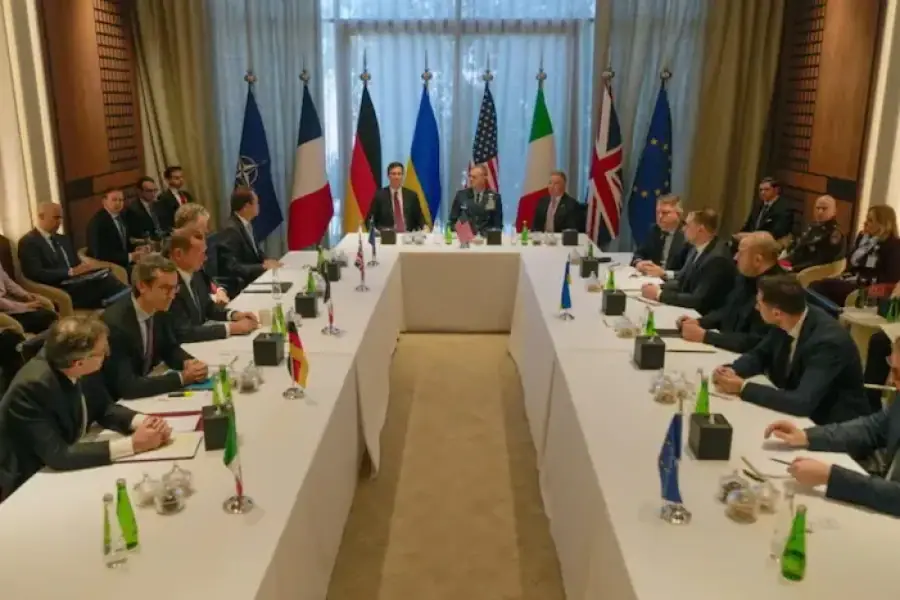
The path to peace in the Russia-US-Ukraine conflict is complex and requires addressing several key questions. According to a report on Maliweb.net, a negotiation has begun in Ukraine when someone can answer three questions: who can commit their government, what are the discussion points, and what happens if one signatory breaches the agreement. Until then, even a high-level meeting can serve to test the opponent, reassure allies, or assess public opinion patience.
The United States can play a significant role in opening the path to peace, as they maintain direct relations with Moscow, influence conditions for Kiev to pursue combat, and have leverage on Western sanctions. A US president can test the Kremlin through a trusted emissary, and the value of this channel is measured when it leads to commitments involving Congress, allies, or Ukrainian authorities. However, for an agreement to be guaranteed, institutions that can support it beyond a presidential term are necessary.
For Kiev, the issue is concrete: if Ukraine agrees to stop fighting along a given line, who guarantees that this line will remain fixed? The Ukrainian government must explain to its citizens what will happen to people who remain in occupied territories, what rights will be preserved for displaced persons, and how cities will be protected against renewed attacks. Defining what military concessions can be made without exposing themselves to a new offensive is also crucial.
A ceasefire line and a recognized border are two distinct things. The first indicates where armies must stop, while the second establishes which state a territory belongs to. Freezing the front line while leaving the sovereignty question open would allow for an end to fighting without requiring Kiev to recognize Russian annexations. However, crucial questions would remain unanswered, including property rights and the right of return for families.
Moscow has an interest in transforming the control acquired on the ground into a lasting political advantage. Discussions on territories go hand-in-hand with those on Ukraine's neutrality, its relations with NATO, and the future configuration of Kiev's armed forces. For the Kremlin, limiting Ukraine's access to certain weapons or preventing it from concluding military agreements can have equivalent value to a territorial concession.
A ceasefire commitment must specify which actions are prohibited, such as an attack on a power plant far from the front or a drone crossing the demarcation line. Signatories must define who will verify facts and what consequences will follow a proven violation. A more targeted agreement, such as protecting energy infrastructure, would allow testing the parties' ability to respect a limited obligation.
Europe has resources but needs a political decision to mobilize them. The European Union can support the Ukrainian budget, finance reconstruction, and act on sanctions. However, a weakness lies in the gap between available resources and the ability to mobilize them through a common decision.
Key points
- The path to peace requires addressing key questions, including who can commit their government and what happens if one signatory breaches the agreement.
- The US and Europe have significant roles to play in supporting a peace agreement.
- A ceasefire commitment must specify prohibited actions and consequences for violations.
Reporting sources
- Russie-États-Unis-Ukraine : les étapes... · Maliweb.net