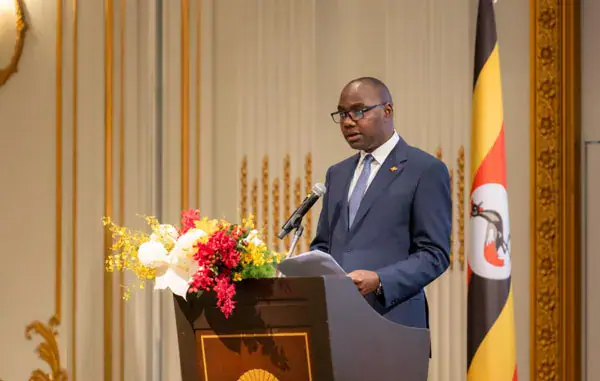
Finance Minister Henry Musasizi has called on commercial banks in Uganda to lower lending rates and increase access to credit for businesses. He made the remarks at the second Annual Bankers' Awards in Kampala, where he was the chief guest. Musasizi noted that despite the banking sector's improved financial performance, businesses and individuals continue to face stringent borrowing requirements. He emphasized that Uganda's ambition of building a $500 billion economy would be difficult to achieve unless financial institutions expanded private sector lending.
The banking sector in Uganda has recorded significant growth, with total assets increasing to Shs 61.7 trillion and net profits reaching Shs 2.17 trillion. Non-performing loans have declined to 2.67 percent, the lowest level recorded since 2011. However, private sector credit currently accounts for approximately 14 percent of Uganda's Gross Domestic Product (GDP), below the government's target of 25 percent by 2030. Musasizi urged banks to reconsider their lending practices and channel more resources towards manufacturers, commercial farmers, and technology innovators.
Musasizi challenged financial institutions to reduce lending rates, which currently hover around 18 percent, through digital innovation and shared infrastructure that could lower operational costs. He noted that high lending rates hinder businesses from growing their enterprises, as they spend half their energy working to settle bank loans. The minister's call for more affordable credit comes amid concerns about the cost of financial intermediation in Uganda.
The International Monetary Fund (IMF) has identified high interest-rate spreads and elevated operational costs as constraints affecting private sector financing in Uganda. The IMF also observed that commercial banks hold a significant proportion of their assets in government debt, highlighting the need to deepen financial markets and strengthen lending to private businesses.
Bank of Uganda Director Bosco Bainamazima reported that the banking sector had recorded significant growth in the year ending June 2026. Total industry assets increased by Shs 9.25 trillion, representing 16.7 percent growth. Lending expanded by Shs 3.2 trillion, equivalent to 14 percent, while deposits grew by Shs 6.35 trillion, representing 15.6 percent. Bainamazima challenged financial institutions to ensure that their expanding balance sheets translated into tangible economic benefits.
The Uganda Institute of Banking and Financial Services (UIBFS) Board Chairperson Godfrey Sebaana reaffirmed the industry's commitment to supporting the government's Tenfold Growth Strategy. Sebaana revealed that financial institutions had submitted proposals to the Bank of Uganda outlining their contribution towards achieving the country's $500 billion economy ambition.
At the awards ceremony, Stanbic Bank emerged as Bank of the Year in the Tier One category, while Pride Bank won the Tier Two award. Julius Kakeeto, the Managing Director of Pearl Bank, was named Banker of the Year. NCBA Bank also secured three awards, including Best Customer Service in Tier One, Best Bank in Corporate Banking, and the Financial Crime Prevention Award.
Key points
- Musasizi challenges banks to lower lending rates to around 18 percent through digital innovation and shared infrastructure.
- Private sector credit currently accounts for approximately 14 percent of Uganda's GDP, below the government's target of 25 percent by 2030.
- The banking sector in Uganda has recorded significant growth, with total assets increasing to Shs 61.7 trillion and net profits reaching Shs 2.17 trillion.
Reporting sources
- Musasizi challenges banks to lower lending rates as profits hit Shs 2.17 trillion · The Independent magazine