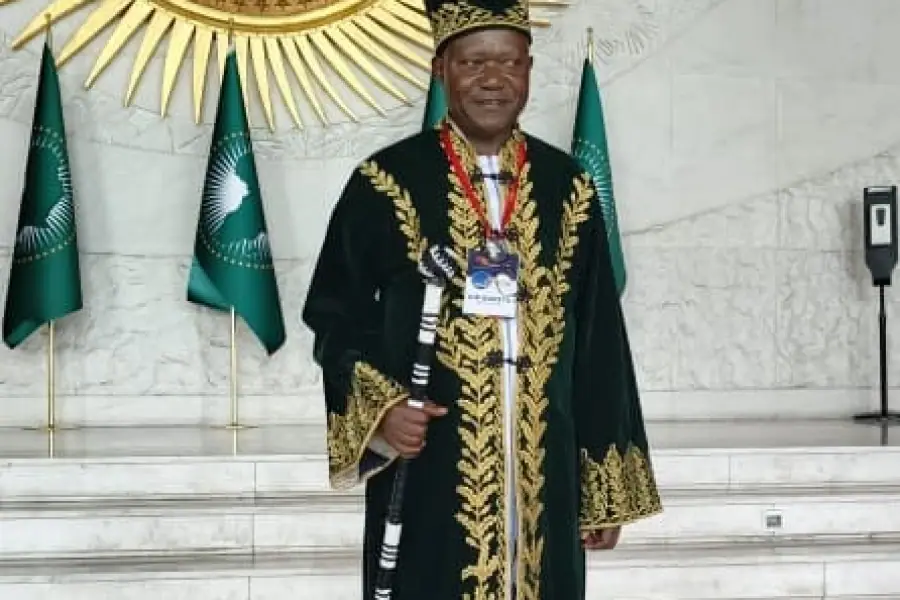
The Umukuuka wa Bugisu, HRH Sir Jude Mike Mudoma III, has outlined an ambitious continental agenda for traditional institutions following his return from the 6th Continental African Traditional Leaders Conference held at the African Union (AU) Headquarters in Addis Ababa, Ethiopia. Mudoma highlighted major resolutions reached at the continental gathering, including the adoption of the Addis Ababa Declaration, the inauguration of the African Traditional Leaders Council (ATLC), and the recognition of traditional leadership as an important partner in Africa’s socio-economic transformation.
One of the significant achievements announced by the Bugisu cultural leader was the elevation of East Africa to a strategic leadership position in the establishment of the new continental council. Mudoma revealed that his delegation successfully secured the position of Vice Chairperson of the Ad Hoc Interim Committee responsible for drafting the foundational Charter of the African Traditional Leaders Council. This achievement followed his strong advocacy for equitable regional representation across the five geographical regions of the African Union.
Mudoma described the unanimous adoption of the Addis Ababa Declaration as a historic milestone that formally anchors traditional leadership within Africa's broader continental development framework. The declaration emerged from deliberations involving kings, queens, chiefs and cultural custodians from different parts of Africa and the global African diaspora. The conference sought to define how indigenous leadership structures can contribute to Africa's modern transformation while preserving cultural identity, traditional governance systems and indigenous knowledge.
The African Traditional Leaders Council, an independent and nonpartisan continental platform, was inaugurated to preserve African heritage, champion indigenous governance and complement constitutionally established governments. The council is expected to provide a common platform through which traditional institutions can engage continental development processes, promote peace and contribute to sustainable economic development. Mudoma emphasized that traditional institutions should work alongside governments in a complementary relationship based on mutual respect, constitutional order and shared development objectives.
Mudoma said the Addis Ababa conference united traditional institutions around four critical areas that will guide their contribution to Africa's development. These include grassroots peacebuilding, the elevation of women and queenship in leadership, preservation of indigenous knowledge systems, and sustainable economic governance. He explained that traditional leaders have a responsibility to use their influence and community connections to promote peaceful coexistence, strengthen women's participation in leadership and safeguard indigenous knowledge for future generations.
The conference also secured a commitment to connect local artisans, farmers and cultural industries directly to opportunities under the African Continental Free Trade Area (AfCFTA). Mudoma said the initiative recognizes that traditional institutions can play an important role in organizing local producers, strengthening cultural industries and helping communities access wider regional markets. The African diaspora was also recognized as the continent's Sixth Region, reflecting the importance of engaging Africans and people of African descent beyond the continent in heritage preservation and economic development.
A major highlight of Mudoma's participation in the Addis Ababa conference was his presentation of the Dual-Direction Growth Model for African Union Member States and Traditional Leaders. The framework seeks to address what he described as a longstanding disconnect between government development programmes and grassroots communities. He argued that African governments possess legislative authority, macroeconomic policy instruments, financial resources and diplomatic influence, while traditional leaders command community trust, moral authority and custodial responsibility over land, culture and indigenous institutions.
Key points
- The African Traditional Leaders Council was inaugurated to preserve African heritage and champion indigenous governance.
- The Addis Ababa Declaration formally anchors traditional leadership within Africa's broader continental development framework.
- Mudoma presented the Dual-Direction Growth Model to address the disconnect between government development programmes and grassroots communities.
Reporting sources
- Mudoma Champions Government-Traditional... · nilechronicles.com