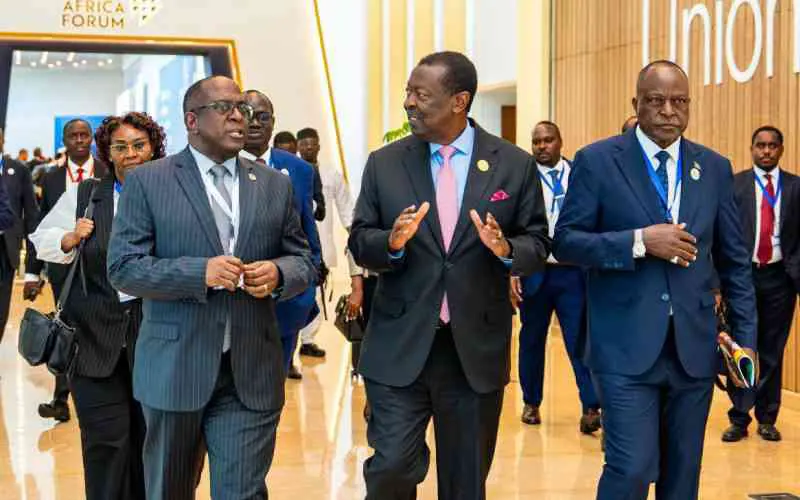
Prime Cabinet Secretary Musalia Mudavadi has urged African countries to deepen economic integration and strengthen regional trade to address mounting global pressures. Speaking at the inaugural Alamein Africa Forum in El Alamein, Egypt, on October 3, 2026, Mudavadi emphasized the need for collective action to translate the African Union's Agenda 2063 into tangible economic benefits. The forum brought together leaders, institutions, and private-sector representatives to discuss the continent's economic trajectory.
Mudavadi noted that the global economy is undergoing a "structural realignment" with rising protectionism, trade tensions, and conflicts affecting Africa. He called for partnerships, policies, and projects that translate Agenda 2063 into economic outcomes that transform African lives. A key concern raised by Mudavadi was Africa's fragmented financial system, which constrains capital movement across borders. He argued that stronger regional financial integration would unlock capital, strengthen economic linkages, and reduce disparities.
The Prime Cabinet Secretary pointed to Kenya's commitment to regional and continental integration, particularly through the African Continental Free Trade Area (AfCFTA). He cited President William Ruto's role as Chair of the Assembly Committee on AfCFTA Implementation as an indication of Kenya's focus on advancing continental trade. Mudavadi said AfCFTA offers Africa an opportunity to accelerate industrialization, strengthen regional value chains, and attract investment, with private-sector participation being crucial.
Mudavadi identified infrastructure and logistics as significant obstacles to efficient trade flows, calling for greater private-sector involvement in developing regional transport networks and shared infrastructure. He cited the East Africa Oil Refinery in Lamu as an example of an African-led project with regional ambitions. The project, backed by the Dangote Group, is expected to support the Lamu Port-South Sudan-Ethiopia-Transport (LAPSSET) corridor, linking Kenya, Ethiopia, and South Sudan.
The Prime Cabinet Secretary described the refinery as evidence of Africa's growing capacity to develop solutions to its own economic challenges. He said the project could generate benefits in regional energy security, value addition, industrialization, and job creation. Mudavadi called for increased investment in regional transport corridors, cross-border digital payment systems, and integrated energy grids to make intra-African trade more seamless.
Mudavadi emphasized the need for structural and institutional reforms to unlock Africa's potential in critical minerals, digital innovation, infrastructure, trade, the creative economy, and its youthful population. He expressed hope that the forum's recommendations would feed into the AU's wider discussions on economic integration. Mudavadi said Africa possesses the human resources, natural resources, and strategic intent required to achieve its development ambitions.
The Alamein Africa Forum was held on the sidelines of the eighth Mid-Year Coordination Meeting of the African Union. The forum aimed to strengthen cooperation between governments and businesses. Mudavadi's call for collective action and economic integration reflects the continent's desire to address global challenges and achieve development goals.
Key points
- Mudavadi urges African countries to deepen economic integration to address mounting global pressures.
- Africa's fragmented financial system constrains capital movement across borders.
- The African Continental Free Trade Area (AfCFTA) offers Africa an opportunity to accelerate industrialization and attract investment.