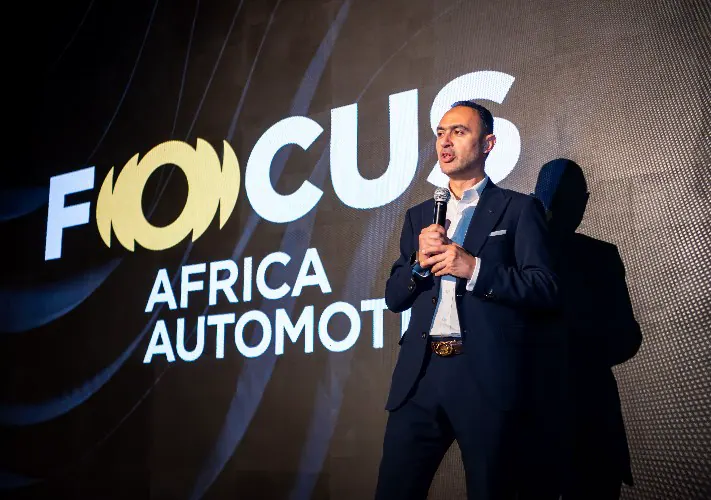
The Nissan Egypt team recently participated in the Africa Science Forum, serving as the official mobility partner. The event brought together government leaders, decision-makers, investors, and business leaders from across the continent. Mohamed Abd El-Samad, Managing Director of Nissan Africa, took part in a panel discussion titled "Enabling Trade: Logistics, Value Chains, and Industry Across Africa." The session focused on opportunities to enhance intra-African trade and the role of infrastructure and logistics in supporting industry competitiveness.
Abd El-Samad also participated in the "Investing in the African Automotive Sector Forum," within a session titled "CEOs' Visions." He reviewed the future of the automotive industry in Africa and the importance of regional integration in supporting manufacturing, investment, and trade. He emphasized that expanding into African markets is not solely dependent on demand size but also on the ability to connect production centers to markets. This involves developing more efficient supply chains and facilitating the movement of vehicles and components between countries.
According to Abd El-Samad, developing Africa's automotive industry requires a comprehensive system that combines manufacturers, suppliers, and logistics services. It is essential to enhance the capabilities of local suppliers to match product development and market needs. He cited Nissan's experience in Egypt, including the local production of the "Nissan Magnite," as an example of the importance of integrating local manufacturing and developing a supplier base.
Egypt is considered a crucial regional manufacturing base for serving African markets, with ongoing efforts to develop the factory's capabilities, increase production, and boost exports. Abd El-Samad noted that industry expansion requires parallel improvements to the transportation, ports, shipping, and border procedures infrastructure. This would facilitate the movement of vehicles and components, enhancing the competitiveness of African products.
During the forum, Nissan showcased the "Nissan Magnite," which began local production at the company's factory in Egypt in June 2026. Egypt became the first African country to produce this model, with a local component ratio of 55% since production started. Rami Maharb, General Manager of Brand and Communications for Nissan Africa, stated that the company's participation in these forums reflects its commitment to supporting the growth of the automotive industry in Africa.
Maharb highlighted that the local production of the "Magnite" represents a model for Egypt's manufacturing and assembly capabilities. Nissan's strategy to expand its locally assembled vehicle lineup aims to support the Egyptian market and create growth and export opportunities. The company's factory provides around 1,000 direct jobs and 5,000 indirect jobs. Nissan has invested an additional $45 million to develop passenger car assembly lines and prepare the factory for "Magnite" production.
The investment has increased the factory's annual production capacity to 50,000 vehicles, exceeding the previous capacity by 10,000 vehicles per year. Nissan Egypt's exports have surpassed 25,000 vehicles in recent years, with total investments in the factory exceeding $276 million. The company aims to enhance Egypt's role as a regional hub for manufacturing and exporting to African markets.
Key points
- Egypt is considered a crucial regional manufacturing base for serving African markets.
- Local production of the "Nissan Magnite" in Egypt reached a 55% local component ratio.
- Nissan Egypt's factory provides around 1,000 direct jobs and 5,000 indirect jobs.