MSC Cruises managing director Ross Volk has reaffirmed the company's commitment to Durban as its South African home port, despite a subdued business backdrop in the city. The company's decision comes as its MSC Armonia ship makes its debut for the 2026/27 cruise season, sailing out of Durban. Volk emphasized that bringing bigger ships to the region requires more than just port infrastructure, but also a capable city and regional infrastructure within Southern Africa.
The Durban Business Confidence Index has fallen for a third consecutive quarter to 47.97 in the third quarter of 2026, below the neutral level of 50. This decline reflects the challenges facing Durban's broader economy. According to a report by University of KwaZulu-Natal economists Harold Ngalawa and Ntokozo Nzimande, the index declined 1.74% from the previous quarter and was 7.96% below its level a year earlier. Despite this, perceptions of municipal service delivery improved for a second consecutive quarter.
The business confidence report highlights concerns about service delivery in Durban, with 69.6% of respondents believing the municipality is unlikely to address service delivery complaints within a reasonable time. Water supply was identified as the worst service by 33.9% of respondents, followed by public safety at 30.4% and roads at 21.4%. Volk, however, rejects the suggestion that Durban is a problematic metro, citing MSC's 30-year history of home-porting in the city.
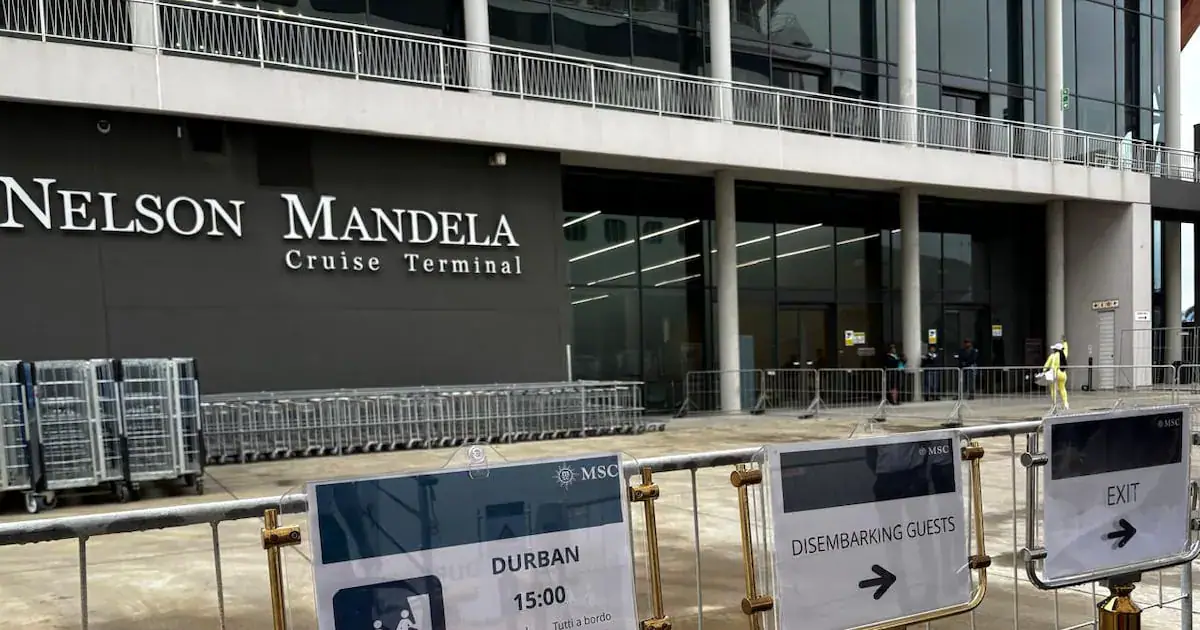
Volk emphasized that MSC has invested in Durban, having built the cruise terminal behind him. He believes Durban offers the best opportunity for MSC to offer cruising in Southern Africa to destinations in Mozambique, Mauritius, and elsewhere. The company's MSC Armonia ship brings a new level of luxury to the South African market, with upgraded cabins, lounges, and amenities. Volk describes it as similar in size to mid-class liner MSC Opera, with a slightly longer season providing additional passenger capacity.
The prospect of substantially larger vessels in the region, however, depends on the capacity of destinations across Southern Africa to accommodate more passengers. Volk noted that Durban's cruise terminal can accommodate 5,000 passengers, rising to 6,500 with some infrastructure changes. However, he questioned whether the city of Durban is ready to accommodate 6,500 people, pointing to destinations including Cape Town, Gqeberha, Walvis Bay, and Maputo as part of the wider capacity question.
MSC is working with Wesgro on a national cruise strategy, which Volk hopes will emerge within the next couple of years. He believes that cruise growth needs to be integrated with the rest of the tourism economy, from airports and roads to hotels, attractions, and small businesses. By creating stronger opportunities for these businesses to participate in the tourism value chain, growth can have a wider economic impact.
Volk's vision for cruise growth in the region emphasizes the importance of a seamless visitor journey. He noted that ports need to work with airports, roads, transport providers, hotels, attractions, and tourism authorities to make the visitor experience as smooth as possible. For international visitors, a cruise can also form part of a longer South African holiday, creating opportunities to stay before or after their cruise and experience more of what the country has to offer.
Key points
- MSC Cruises' growth plans for Durban depend on regional readiness to handle larger passenger volumes.
- The company's commitment to Durban is driven by its 30-year history of home-porting in the city and its potential for offering cruising in Southern Africa.
- A national cruise strategy is being developed with Wesgro to integrate cruise growth with the rest of the tourism economy.
Reporting sources
- # 3 Cruise growth in Durban hinges on regional readiness · The Sunday Times