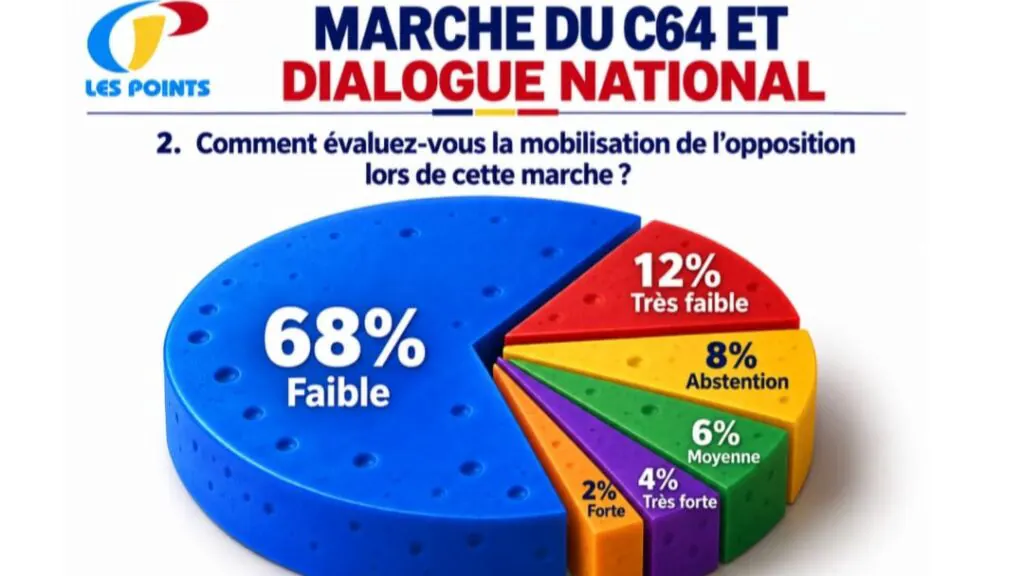
A recent survey conducted by LES POINTS has revealed that 68% of Congolese people view the mobilization of the C64 opposition during a recent march as weak. The survey, which was conducted in various parts of the country, including provincial capitals, aimed to gauge public opinion on the march and the national dialogue. The results show that a significant majority of Congolese people do not consider the mobilization to be strong.
The survey, which was conducted after the C64 march on September 15, 2026, had a wide reach, covering not only Kinshasa but also provincial capitals, with the exception of those directly affected by armed conflicts. The survey aimed to provide a broad perspective on Congolese public opinion, taking into account various political trends, civil society, and the majority of the population that does not identify with any particular political trend. The survey's results provide valuable insights into the perceptions of the Congolese people.
According to the survey, 84% of respondents reported being aware of the C64 march, while 9% said they were not aware, and 7% abstained from responding. However, when asked to evaluate the mobilization during the march, 68% of respondents described it as weak, and 12% described it as very weak. Only 4% of respondents considered the mobilization to be very strong, and 2% considered it to be strong. The survey's results suggest that the mobilization did not have a significant impact on the public.
The survey also found that 53% of respondents believe that the C64's rejection of the national dialogue is not justified, while 31% believe it is not justified at all. Only 5% of respondents consider the rejection to be justified, and 6% consider it to be fully justified. The results suggest that the majority of Congolese people do not support the C64's rejection of the dialogue. The government's position on the dialogue has been a point of contention.
The survey also gathered opinions on the participation of individuals and groups involved in armed conflicts in the national dialogue. A significant majority of respondents, 62%, believe that they should not participate in the dialogue. However, 17% of respondents believe that they should be allowed to participate if they renounce violence, and 4% believe that it depends on the conditions of participation. Only 6% of respondents believe that all groups should be allowed to participate.
The survey also found that 68% of respondents are very favorable to the idea of starting the national dialogue with consultations at the local level, followed by a national stage in Kinshasa. A further 13% of respondents are somewhat favorable to the idea. The results suggest that the majority of Congolese people support the proposed format for the national dialogue. The presidency has presented the dialogue as a framework for consultation.
Finally, the survey found that respondents want a diverse representation in the local consultations, with 71% citing the need for representation from the majority and opposition parties, 68% citing the need for representation from areas affected by conflicts, and 67% citing the need for representation from civil society. The results suggest that the Congolese people want a broad and inclusive dialogue that takes into account the views of various stakeholders.
Key points
- 68% of Congolese people view the C64 opposition's mobilization as weak.