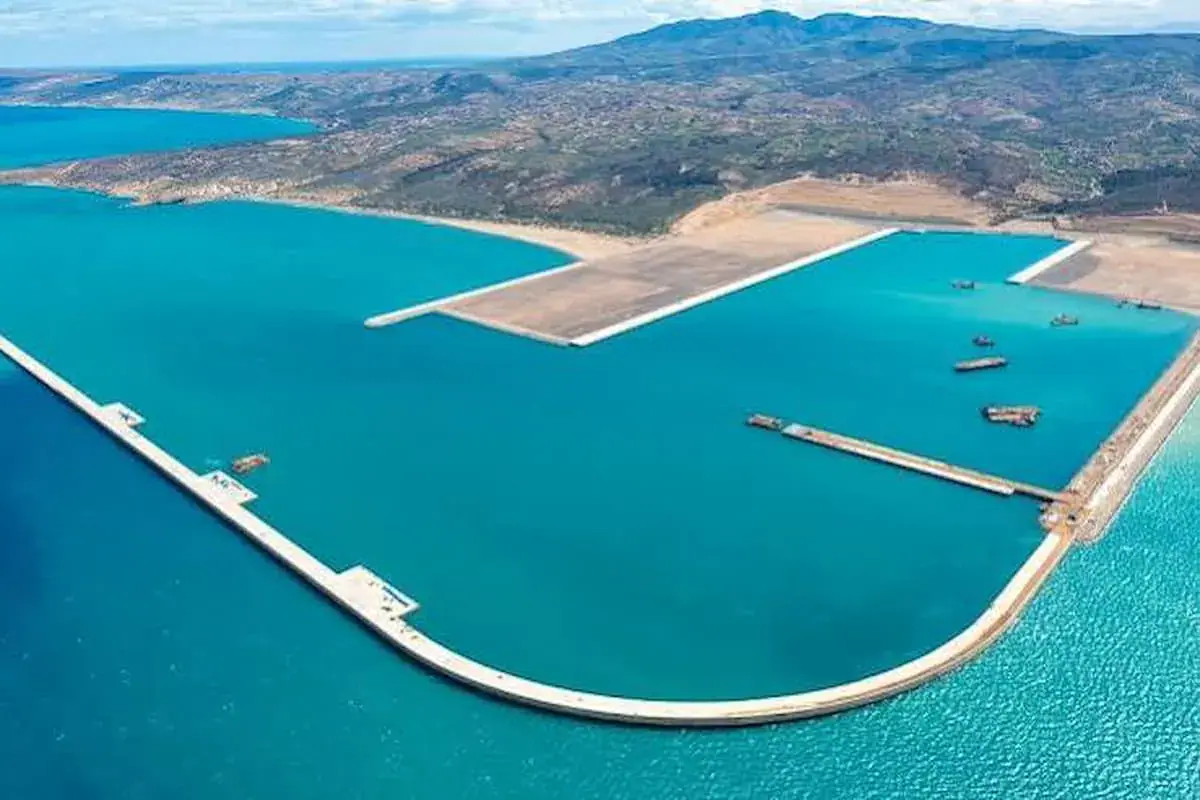
The Moroccan government is preparing to open the first terminal of the Nador West Med port, a major project that represents a public and private investment of 54 billion dirhams, approximately $5.5 billion. The terminal will have an annual capacity of 3.5 million containers. This project is part of a larger plan to strengthen the country's logistics, industrial, and energy capabilities, as announced by the Royal Cabinet in a statement released on October 28.
The Nador West Med complex will also feature a second terminal with a capacity of 1.8 million containers, expected to be operational by April 2027. Additionally, the project includes energy infrastructure, such as a hydrocarbon terminal, storage facilities with a capacity of up to four million cubic meters, and a liquefied natural gas terminal. The industrial zone already hosts one operational factory, while three others are under construction.
The Nador West Med project is expected to generate 14,000 direct jobs and 20,000 indirect jobs in the short term. The complex will also contribute to the country's economic growth and development. The Royal Cabinet statement emphasized that these projects align with Morocco's strategic objectives, including strengthening its integration into global value chains by combining maritime transport, industry, logistics, and energy supply.
In parallel, Morocco plans to launch the Tanger Med 3 project, valued at eight billion dirhams. Located west of Tanger Med 2, the new port will feature 1,200 meters of quays and add a capacity of 4.5 million containers per year. A concession contract has been signed with Maersk-APM to develop the new container terminal. This expansion will bring the total capacity of the Tanger Med complex to 20 million containers per year, up from 11.1 million containers handled in 2025.
The Tanger Med 3 project also includes the development of passenger facilities and international goods transport by truck. The project's impact will depend on the quality of land connections, the attraction of new operators, and the ability to transform port flows into jobs and local added value. Morocco's investments in these projects aim to enhance its position in global trade and strengthen its economic ties with other countries.
The development of Nador West Med and Tanger Med 3 ports is part of Morocco's strategy to increase its integration into global value chains. By combining transport, industry, and logistics, the country aims to boost its economic growth and create new job opportunities. The successful implementation of these projects will depend on various factors, including the quality of infrastructure and the level of investment.
The Moroccan government's efforts to develop its port infrastructure are expected to have a positive impact on the country's economy. The growth of the logistics and industrial sectors will contribute to Morocco's economic diversification and competitiveness. The implementation of these projects will also enhance the country's attractiveness to foreign investors and strengthen its position as a major player in regional trade.
Key points
- Morocco is investing in two major port projects, Nador West Med and Tanger Med 3, to boost its logistics, industrial, and energy capacities.
- The Nador West Med project represents a $5.5 billion investment and is expected to generate 14,000 direct jobs and 20,000 indirect jobs.
- The Tanger Med 3 project aims to increase the total capacity of the Tanger Med complex to 20 million containers per year.