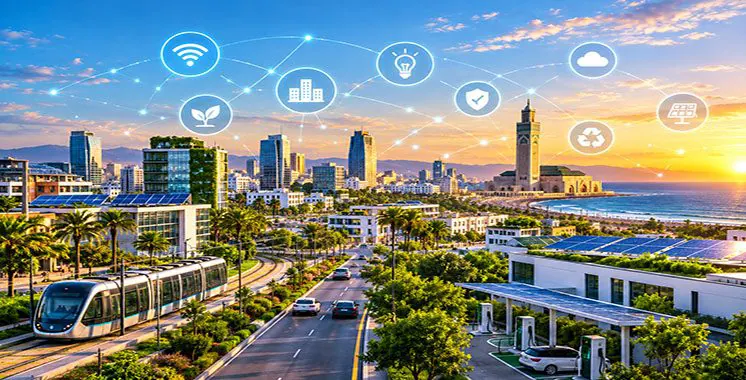
The Moroccan government has initiated a study to create a national reference framework for smart cities, focusing on governance, mobility, energy, environment, water, digitalization, and social inclusion. This framework is designed to support the country's growing urbanization, foster innovation, and enhance the sustainability and competitiveness of Moroccan cities. The study, launched by the relevant ministry, will identify key challenges to transitioning to smart cities, including financial and technical constraints, as well as issues related to digital divide.
The study will begin by assessing existing smart city initiatives in Morocco and internationally, identifying success factors, obstacles, and lessons learned. It will also map out stakeholders, including public and private actors, academia, and civil society, analyzing their roles, contributions, and potential synergies. Furthermore, the study will categorize Moroccan cities based on their digital maturity, size, socio-economic context, functions, attractiveness factors, and development priorities.
The future framework will define strategic and operational axes covering key components of smart cities, such as governance, mobility, energy, environment, water management, security, urban planning, climate resilience, social inclusion, digital economy, open data, and citizen participation. It will also establish indicators and standards to monitor, evaluate, and certify smart city projects, aligning with international benchmarks.
The study aims to address the main obstacles to transitioning to smart cities, including financial and technical constraints, as well as challenges related to the digital divide. An operational toolkit will be proposed to local authorities and stakeholders, comprising methodological guides, governance models, financing mechanisms, and technological solutions. A national roadmap will complement the framework, outlining the steps, priorities, resources, and governance mechanisms necessary for its progressive implementation.
The development of this framework is crucial in the context of Morocco's accelerating urbanization, with the urban population expected to grow significantly. The country's urbanization rate reached 62.8% in 2024 and is projected to reach 74% by 2050. The framework is expected to contribute to the United Nations' Sustainable Development Goals (SDGs), through an approach based on innovation, integrated management, and continuous evaluation of urban policies.
Morocco has already launched several initiatives in line with its smart city ambitions, including the "Morocco Digital 2030" strategy, e-government programs, startup initiatives, the National Climate Plan, and the New Development Model. Several projects, such as the Green City of Benguerir, the Zenata eco-city, and Casablanca Smart City, demonstrate the country's commitment to innovation, sustainability, and connected services.
The framework's development will also lead to recommendations on the evolution of the regulatory and institutional framework, aiming to promote innovation, investment, and cooperation among stakeholders. The ministry emphasizes that this approach will support the SDGs, through a focus on innovation, integrated management, and continuous evaluation of urban policies, ultimately enhancing the quality of life for Moroccan citizens.
Key points
- The Moroccan government has launched a study to develop a national smart city framework, aiming to support the country's growing urbanization and enhance the sustainability and competitiveness of its cities.
- The framework will focus on key components of smart cities, including governance, mobility, energy, environment, and digitalization.
- The study will identify obstacles to transitioning to smart cities and propose an operational toolkit to support local authorities and stakeholders.