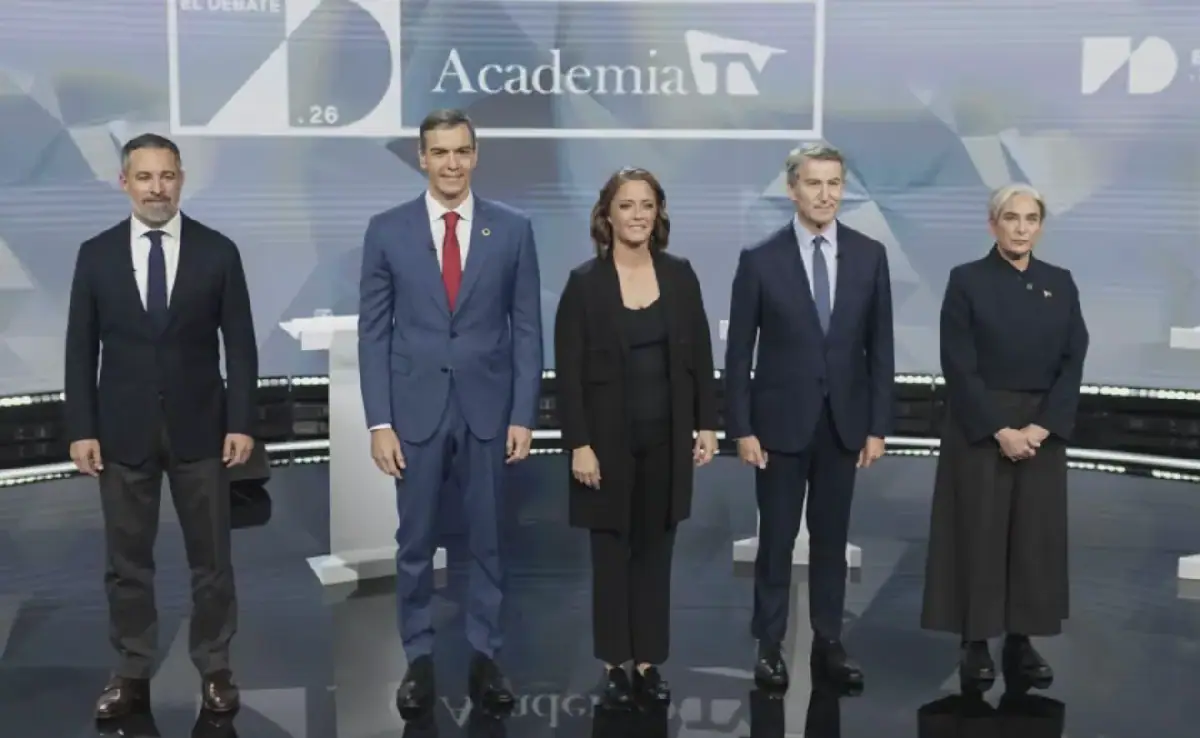
The recent Spanish election debate featured a discussion on Morocco, with candidates from various parties sharing their views on the country's relationship with Spain. The debate, which included leaders from the Spanish Socialist Workers' Party, the People's Party, Vox, and the United Left, touched on issues such as migration, the 2030 World Cup bid, and the status of Ceuta and Melilla. Morocco's role in the migration crisis was a significant topic, with Vox leader Santiago Abascal criticizing the Moroccan government for its handling of the situation.
Abascal claimed that 100,000 irregular migrants had entered Morocco from Spain, and that the Moroccan government had made statements suggesting it had sovereignty over Ceuta and Melilla. He also accused the Spanish government of being too soft on Morocco, saying that Prime Minister Pedro Sánchez had chosen to engage in a diplomatic dispute with Italy instead of taking a firmer stance on migration. Abascal's comments were met with a response from Sánchez, who accused him of being the "Moroccan candidate" in the election.
The People's Party leader, Alberto Núñez Feijóo, also weighed in on the issue, criticizing Sánchez's government for its handling of the migration crisis in Ceuta. Feijóo argued that the government's policies had created a "pull effect" that had encouraged more migrants to make the journey to Spain. The debate highlighted the complexities of the relationship between Spain and Morocco, particularly on issues related to migration and territorial disputes.
The 2030 World Cup bid was another topic of discussion, with Abascal expressing his opposition to a joint bid with Morocco. He argued that Spain could not collaborate with Morocco while the country was "occupying" Ceuta and Melilla. Feijóo, on the other hand, questioned the location of the World Cup final, suggesting that it was unclear whether the match would be held in Spain or Morocco.
Sánchez responded to his opponents' comments by accusing them of lacking patriotism and being overly influenced by external factors. He pointed out that he was the only one of the three leaders who had served in the military and sworn allegiance to the Spanish flag. Sánchez's comments were seen as an attempt to shift the focus away from Morocco and onto his own credentials as a patriot.
The debate highlighted the challenges of navigating complex relationships between countries, particularly in the context of migration and territorial disputes. Morocco's role in the region and its relationship with Spain will likely continue to be a topic of discussion in the lead-up to the election. The candidates' comments on Morocco and migration reflect the complexities of the issue and the need for nuanced solutions.
The Spanish election debate has significant implications for the country's relationship with Morocco and its approach to migration and territorial disputes. The outcome of the election will likely have a major impact on Spain's foreign policy and its relationships with neighboring countries. As the country prepares to head to the polls, voters will be watching closely to see how the candidates plan to address these complex issues.
Key points
- Morocco's role in the migration crisis was a major topic of discussion in the Spanish election debate.
- The 2030 World Cup bid was also a topic of discussion, with candidates expressing differing views on a joint bid with Morocco.
- The debate highlighted the complexities of the relationship between Spain and Morocco, particularly on issues related to migration and territorial disputes.