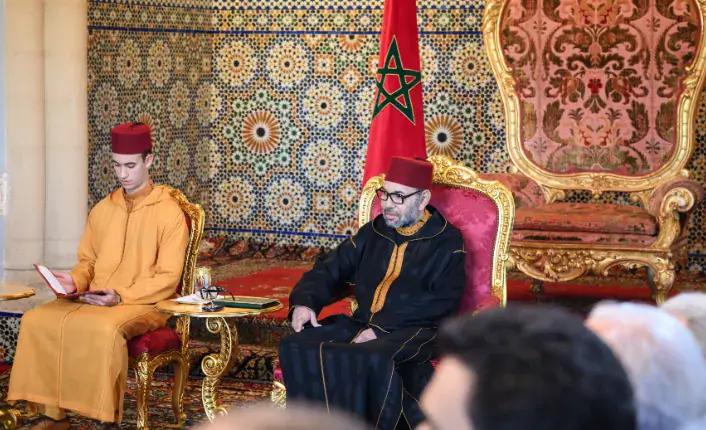
King Mohammed VI of Morocco recently chaired a signing ceremony for two framework agreements aimed at financing the development of the country's defence and security industry. The ceremony, held at the Royal Palace in Rabat, was attended by Crown Prince Moulay El Hassan and senior government officials. These agreements are intended to accelerate the implementation of Morocco's roadmap for developing a national defence and security industry under the country's strategic industrial development agenda.
The agreements were signed by eight officials, including Abdelouafi Laftit, Minister of the Interior, and Fouzi Lekjaa, Minister of Economy, Finance and Public Performance. The first agreement concerns financing the implementation of the roadmap, while the second focuses on mobilising the private and financial sectors to support its implementation. This initiative is consistent with Morocco's broader ambition to establish a sovereign, efficient and competitive national defence and security industrial and technological base.
According to Ali Seddiki, Director-General of the Moroccan Investment and Export Development Agency, Morocco has undergone significant industrial transformation under King Mohammed VI's leadership. The country has positioned itself among emerging countries in advanced industrial sectors, supported by its industrial capabilities, assets and human capital. Seddiki noted that the defence and security industry would contribute to the transformation of the national economy by creating opportunities for investment and strengthening industrial capacity.
The implementation of the roadmap is expected to enable manufacturers operating in Morocco to meet 40 per cent of the requirements of the Royal Armed Forces and security agencies. At full operational capacity, the industry is projected to generate annual revenue of at least 50 billion Moroccan dirhams, with more than 65 per cent coming from exports. The initiative is also expected to create nearly 50,000 direct and indirect jobs by 2035.
Seddiki said particular attention would be given to human capital development through specialised training and the establishment of a national research and development ecosystem. The ecosystem would draw on the expertise and skills of Moroccans living both at home and abroad to support the country's industrial ambitions. The King has also directed the establishment of effective governance structures to ensure the swift implementation of the roadmap.
The Defence Industry Facilitation and Acceleration Agency would coordinate and monitor the commitments of public and private-sector stakeholders. The agency would support the development of weapons production, particularly drones and autonomous systems, land-based and naval systems, defence electronics, cyber defence and artificial intelligence. Its activities would include mobilising industrial offsets, public procurement and skills development to strengthen Morocco's industrial sovereignty.
An unprecedented mobilisation of public-sector partners has helped secure nearly 22 billion Moroccan dirhams for the strategic initiative. The King's directives aim to increase private investment to two-thirds of total national investment by 2035, with the defence and security industry expected to contribute to achieving that target. The initiative presents private-sector operators with a historic investment opportunity in new and innovative industrial activities.
Key points
- Morocco signs two framework agreements to finance defence and security industry development
- The agreements aim to accelerate the implementation of Morocco's roadmap for developing a national defence and security industry
- The initiative is expected to create nearly 50,000 direct and indirect jobs by 2035 and generate annual revenue of at least 50 billion Moroccan dirhams
Reporting sources
- Morocco signs two agreements to finance defence, security industry development · Ghana News Agency