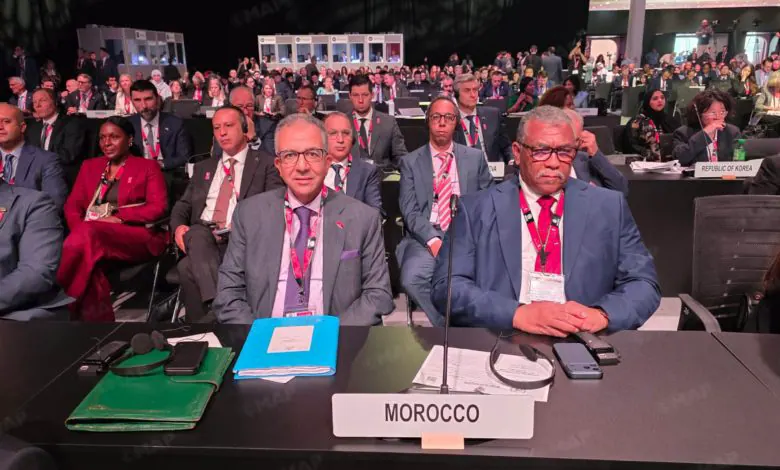
Morocco showcased its national experience in preventing crime and extremism at the 15th UN Congress on Crime Prevention and Criminal Justice, held in Abu Dhabi from September 26 to October 1, 2026. The country's experience was presented by Hicham Moulati, Director of Criminal Affairs, Pardon, and Crime Monitoring at the Ministry of Justice. Moulati highlighted Morocco's national criminal policy, which is based on evidence and focused on human-centered justice.
Moulati emphasized Morocco's commitment to preventing crime, which is considered a crucial aspect of addressing the phenomenon of crime. He outlined the country's approach, which consists of two main pillars: a national, forward-looking criminal policy based on evidence and a human-centered justice system. The Moroccan approach also involves proactive crime monitoring, reducing recidivism, and adopting evidence-based responses.
The Moroccan delegation showcased the experience of the National Observatory for Crime, an institutional mechanism that aims to build an evidence-based criminal policy. The Observatory brings together various stakeholders, including judicial and security institutions, to monitor and analyze crime trends and provide a reliable knowledge base for policymakers. Moulati highlighted the Observatory's work in producing studies on crime in Morocco and developing a national crime map.
The National Observatory for Crime has developed a range of studies on crime in Morocco, using a national perspective that takes into account the specificities of the phenomenon and its determinants. The Observatory has also developed partnerships with national universities to strengthen the role of scientific research in supporting criminal decision-making. Moulati noted that Moroccan judicial and security institutions have specialized units for collecting and analyzing data on crime.
Moulati also presented the "Musalaha" program, a Moroccan experience in preventing extremism and reducing recidivism. The program, launched in 2017, is based on a rehabilitative approach that goes beyond the punitive aspect of addressing the intellectual and social aspects of extremism. The program has three main components: reconciliation with oneself, reconciliation with the divine text, and reconciliation with society.
The "Musalaha" program has achieved significant results, including the participation of 480 inmates in 21 sessions since its launch in 2017. Moulati reported that none of the program's beneficiaries have been recorded as repeat offenders, and that 14 female inmates who participated in the program have been released, with the most recent release occurring on August 24, 2026.
Moulati emphasized the importance of coordination between criminal policy and various public policies in preventing and combating crime. He also stressed the need for the involvement of civil society in crime prevention efforts, given their proximity to citizens and the roles they play in society. The Moroccan experience in preventing extremism and promoting evidence-based crime prevention was presented as a model for other countries to follow.
Key points
- Morocco's experience in preventing extremism and promoting evidence-based crime prevention was showcased at the 15th UN Congress on Crime Prevention and Criminal Justice.
- The "Musalaha" program has achieved significant results in reducing recidivism among inmates.
- Morocco's approach to preventing crime is based on a national, forward-looking criminal policy and a human-centered justice system.