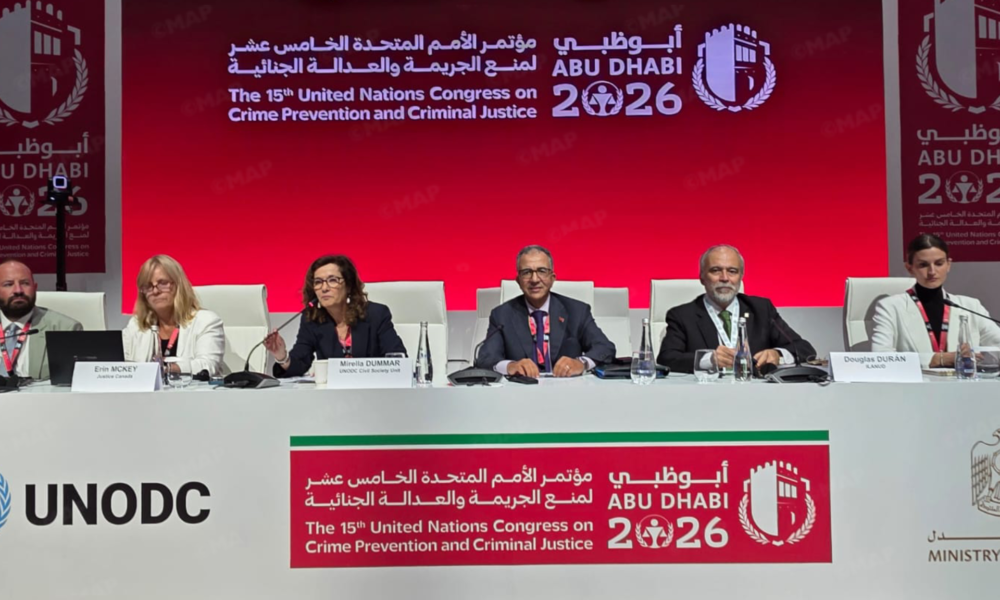
Morocco's experience in preventing crime through data-driven approaches was highlighted at the 15th UN Congress on Crime Prevention and Criminal Justice in Abu Dhabi. The country's delegation, led by Hicham Mellati, Director of Penal Affairs, Pardons, and Crime Observation at the Ministry of Justice, presented the main pillars of Morocco's penal response to crime. This approach prioritizes a national prospective penal policy based on factual data and human-centered justice.
The Moroccan penal response is built on several complementary approaches, including the use of factual data, a human-centered approach, complementarity with public policies, and involvement of civil society. Mellati emphasized Morocco's commitment to crime prevention as a crucial aspect of combating crime, focusing on anticipatory observation of crime and reducing recidivism. The country's National Observatory of Crime plays a key role in this effort, providing a reliable knowledge base for authorities to develop and evaluate penal policies.
The National Observatory of Crime was established as an institutional mechanism to support a penal policy based on data and evidence. The observatory brings together various stakeholders, including judicial institutions, law enforcement agencies, and academic institutions, to analyze and observe crime trends. It has conducted several studies on crime in Morocco, using international indicators, and has developed a participatory approach with technical and scientific working groups.
Mellati highlighted the observatory's role in providing a reliable knowledge base for authorities, enabling them to develop and evaluate penal policies. The observatory has also partnered with national universities to strengthen the contribution of scientific research to penal decision-making. Its work includes collecting and analyzing data on crime trends, which informs the development of the national crime map.
The Moroccan penal response also prioritizes a human-centered approach, focusing on victims and offenders alike. This approach is reflected in the country's updated legislative framework and institutional reforms. For example, Moroccan courts have over 500 social assistants providing socio-legal services to justice users, particularly victims, throughout the judicial process.
Morocco has also implemented programs to support victims of violence, including cells for handling cases of violence against women and children, and shelters for victims of human trafficking. The country's "Moussalaha" program, launched in 2017, aims to prevent extremism and reduce recidivism through rehabilitation and social reintegration. The program has shown promising results, with no cases of recidivism among participants.
The "Moussalaha" program is a comprehensive rehabilitation initiative that has engaged 480 participants since its inception. It focuses on reconciliation with oneself, religious texts, and society, alongside rehabilitation and social reintegration programs. According to Mellati, the program's success is evident in the absence of recidivism among its beneficiaries, demonstrating the potential for innovative approaches to crime prevention.
Key points
- Morocco's data-driven approach to crime prevention emphasizes a national prospective penal policy based on factual data and human-centered justice.
- The country's National Observatory of Crime plays a key role in providing a reliable knowledge base for authorities to develop and evaluate penal policies.
- Morocco's "Moussalaha" program has shown promising results in preventing extremism and reducing recidivism through rehabilitation and social reintegration.