The Western Sahara conflict has deep roots in history, dating back to before 1975. According to Youssef Massati, a historian, the issue is linked to the historical relationships between Moroccan sultans and Sahrawi tribes, including oaths of allegiance, appointments, and correspondence. These ties, along with religious and commercial bonds, played a significant role in shaping the conflict. The Spanish colonization of the Saharan coast began in 1884 and continued until Morocco's independence in 1956.
The southern region of Morocco experienced armed confrontations in 1957 and 1958, leading to the recovery of Tarfaya in 1958 and Sidi Ifni in 1969. At the international level, Western Sahara was listed as a non-self-governing territory by the UN in 1963. The Polisario Front was established in 1973, and the following year, the UN General Assembly requested an advisory opinion from the International Court of Justice on the legal status of Western Sahara and its historical ties to Morocco and Mauritania.
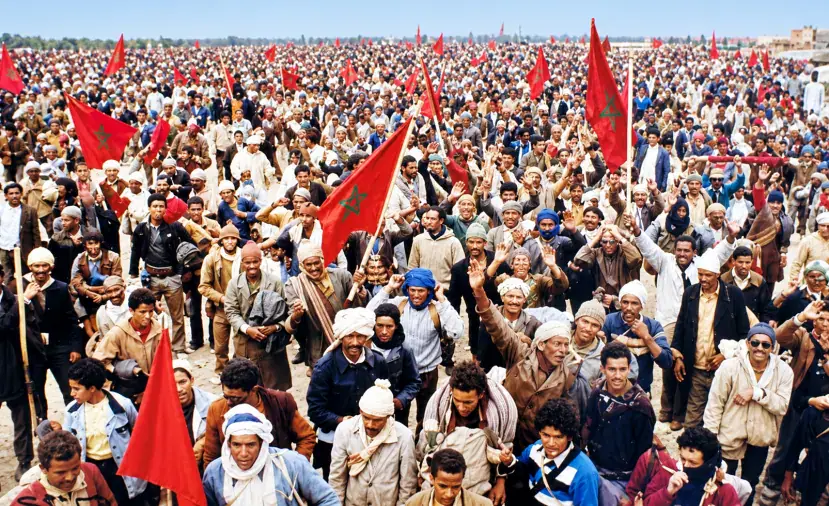
On October 16, 1975, the International Court of Justice issued an opinion that acknowledged the existence of legal bonds of allegiance between the Moroccan Sultan and some tribes in the region. However, the court did not consider these bonds as evidence of Moroccan sovereignty over Western Sahara as a whole. The court also emphasized the principle of self-determination. This ruling set the stage for the Green March, a pivotal event in which around 350,000 Moroccans marched into Western Sahara on November 6, 1975.
The Green March led to the signing of the Madrid Accords on November 14, 1975, between Morocco, Mauritania, and Spain. The accords established a temporary administrative arrangement, which ultimately led to the withdrawal of Spanish forces in 1976. This marked a shift in the conflict, as Morocco and the Polisario Front engaged in armed confrontations. Mauritania's withdrawal from the conflict in 1979 led to a change in the dynamics, with the conflict transitioning from a fight against Spanish colonization to a search for a diplomatic solution.
In 1988, Morocco and the Polisario Front accepted UN proposals for a settlement. The UN Security Council established the MINURSO mission in 1991 to oversee a ceasefire and prepare for a referendum. However, disagreements over voter eligibility hindered the referendum, and the conflict entered a period of negotiations and UN initiatives, including the James Baker plan. In 2007, Morocco proposed an autonomy initiative for the Sahrawi regions as a potential solution to the conflict.
The UN Security Council has continued to address the conflict, with Resolution 2797, adopted on October 31, 2025, extending the mandate of MINURSO. The resolution's recent expiration has led to a new phase in the conflict, with Morocco's autonomy initiative remaining a central aspect of the negotiations. Historian Massati emphasizes that the autonomy initiative is a crucial element in the current stage, and its implications will be significant in determining the future of Western Sahara.
As the conflict continues, Morocco's autonomy initiative and the MINURSO mission's future will play a crucial role in shaping the region's future. The international community remains engaged, with the UN Security Council set to revisit the issue. The Western Sahara conflict's evolution from a fight against Spanish colonization to diplomatic negotiations underscores the complexities of resolving long-standing disputes.
Key points
- The Green March of 1975 marked a pivotal moment in the Western Sahara conflict, shifting the focus from resisting Spanish colonization to diplomatic negotiations.
- The International Court of Justice's 1975 opinion acknowledged historical ties between Moroccan sultans and Sahrawi tribes but did not establish Moroccan sovereignty over Western Sahara.
- Morocco's 2007 autonomy initiative for the Sahrawi regions remains a central aspect of negotiations to resolve the conflict.