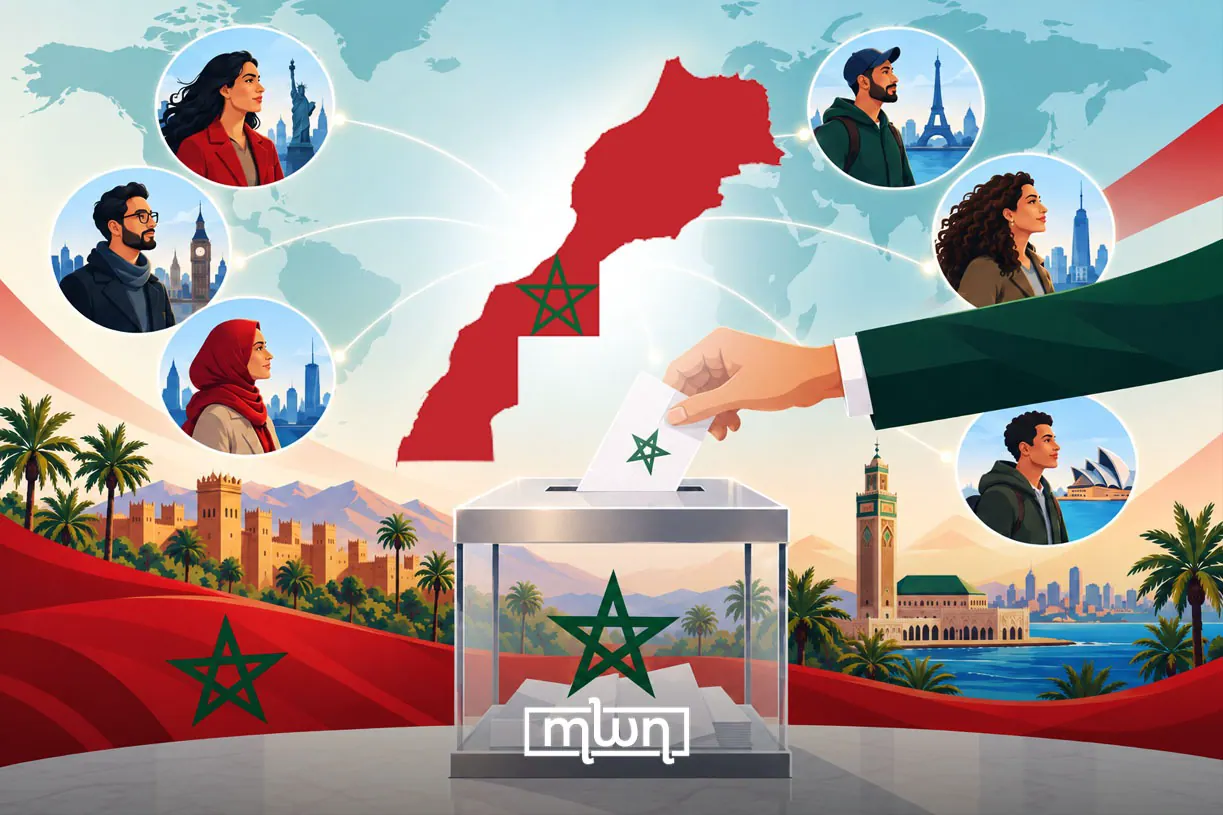
Morocco is set to hold its fourth parliamentary election since the adoption of the 2011 Constitution on September 23, 2026. The constitutional reform made significant commitments to the over 5 million Moroccans living outside the country, recognizing them as full citizens with political rights, including voting and eligibility for election. However, fifteen years later, this constitutional commitment remains only partially realized.
The 2011 Constitution contains several provisions addressing the rights and political participation of Moroccans residing abroad. Article 16 commits the state to protecting their rights and interests, while Article 17 recognizes their full citizenship rights, including voting and eligibility for election. Article 18 requires public authorities to promote participation in consultative and good-governance institutions. Despite this framework, the practical conditions and modalities for exercising these rights from abroad have not been fully implemented.
The current legal framework provides Moroccans residing abroad with a mechanism for proxy voting, allowing them to authorize another eligible voter in Morocco to cast their ballot on their behalf. For the 2026 parliamentary election, the government introduced the E-Procuration platform, making the procedure easier administratively. However, this platform does not enable electronic voting, and the ballot is still physically cast in Morocco by another voter acting as proxy.
The introduction of E-Procuration has generated reports of technical difficulties for some users. Moroccans residing abroad have encountered problems accessing the platform, including issues with national identification numbers not being recognized. These technical problems create additional practical barriers for Moroccans residing abroad attempting to use the new proxy-voting mechanism.
The absence of Moroccan parliamentary polling stations in embassies or consulates, where Moroccans residing abroad can personally cast their ballots, remains a significant issue. There are also no dedicated parliamentary constituencies abroad. This is particularly notable, as Morocco demonstrated the administrative feasibility of voting operations abroad during the 2011 constitutional referendum.
The disagreement over proxy voting is not merely about convenience; it concerns the principle of personal voting, confidentiality, and control. Many members of the diaspora and advocacy organizations argue that proxy voting does not provide the same level of political agency as personally casting one's own ballot. The use of proxy voting raises concerns about the ability of Moroccans residing abroad to exercise their constitutional right to vote effectively.
As Morocco moves forward with its parliamentary election, the issue of diaspora participation remains an unfinished question. The government's efforts to modernize the proxy-voting procedure through E-Procuration are a step in the right direction. However, more needs to be done to fully implement the constitutional commitment to the political participation of Moroccans residing abroad.
Key points
- Morocco's 2011 Constitution recognizes the political rights of Moroccans residing abroad, but the implementation of these rights remains incomplete.
- The use of proxy voting has generated controversy, with concerns about personal voting, confidentiality, and control.
- Technical difficulties with the E-Procuration platform have created additional barriers for Moroccans residing abroad attempting to exercise their right to vote.