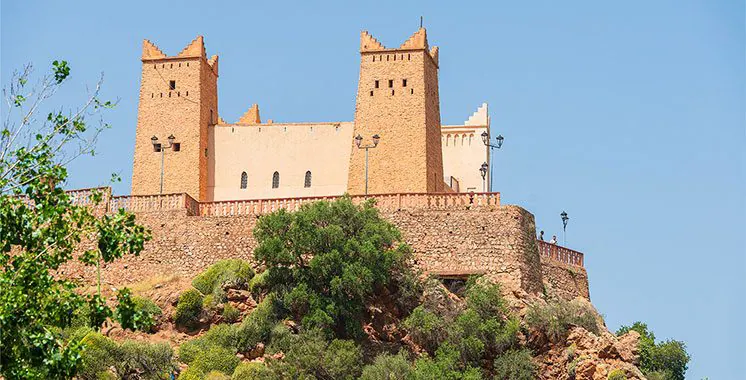
Located in the heart of Morocco's Béni Mellal city, the Ksar d'Aïn Asserdoune is a historic fortress that has stood the test of time. Perched atop a hill, the Ksar offers breathtaking views of the surrounding city and the vast expanse of the Tadla plain. This ancient structure has played a significant role in the region's history, serving as a strategic vantage point for monitoring the surroundings and protecting the nearby source of Aïn Asserdoune.
The Ksar's history is deeply intertwined with the story of the Aïn Asserdoune source, which has been a vital source of water for the region's agricultural activities. The fortress is believed to have been built to safeguard this precious resource and ensure its distribution to the local population. According to historical accounts, the Ksar was constructed using local materials such as stone and pisé, with a compact design that features four towers at its corners. This architectural style was typical of defensive structures in the region.
The Ksar's architecture is a testament to the region's rich cultural heritage. Its elevated position allowed for surveillance of the surrounding area, while its sturdy construction was designed to withstand potential attacks. Local legend has it that the Ksar was built using a human chain, with residents working together to transport materials from the mountain to the construction site. While this story may be more anecdotal than historical fact, it highlights the significance of the Ksar in the local community's collective memory.
Over time, the Ksar has undergone significant changes, with various restoration and renovation projects aimed at preserving its structure. However, these interventions have also altered parts of the original construction, raising concerns about the preservation of the monument's historical integrity. Despite these challenges, the Ksar remains an important cultural and historical landmark in the region. Its significance extends beyond its architectural value, representing a tangible connection to the region's past and its people's traditions.
In recent years, the Ksar has been integrated into a larger tourist complex, featuring walking paths, visitor amenities, and scenic overlooks. This development has helped to promote the site as a major tourist attraction, with visitors drawn to its stunning views and historical significance. For locals, however, the Ksar represents more than just a tourist destination – it is a symbol of their collective heritage and a reminder of the region's complex history.
The Ksar's history is also closely tied to the legend of Aïn Asserdoune, which tells the story of a man who discovered the source of the spring and was rewarded for his efforts. This anecdote has become an integral part of local folklore, highlighting the importance of water in the region's history and culture. As a result, the Ksar has become an important site for understanding the region's cultural and historical context.
Despite its significance, the Ksar's history remains somewhat undocumented, particularly with regards to its exact date of construction. Further research and documentation are needed to fully understand the monument's importance and to preserve its cultural and historical value for future generations. Key points: The Ksar d'Aïn Asserdoune is a historic fortress in Morocco's Béni Mellal city; it was built to protect the nearby source of Aïn Asserdoune and offers panoramic views of the Tadla plain; its history is deeply intertwined with the region's cultural and historical context.
Key points
- The Ksar's architecture is a testament to the region's rich cultural heritage.
- The Ksar has been integrated into a larger tourist complex, featuring walking paths, visitor amenities, and scenic overlooks.
- The Ksar's history remains somewhat undocumented, particularly with regards to its exact date of construction.