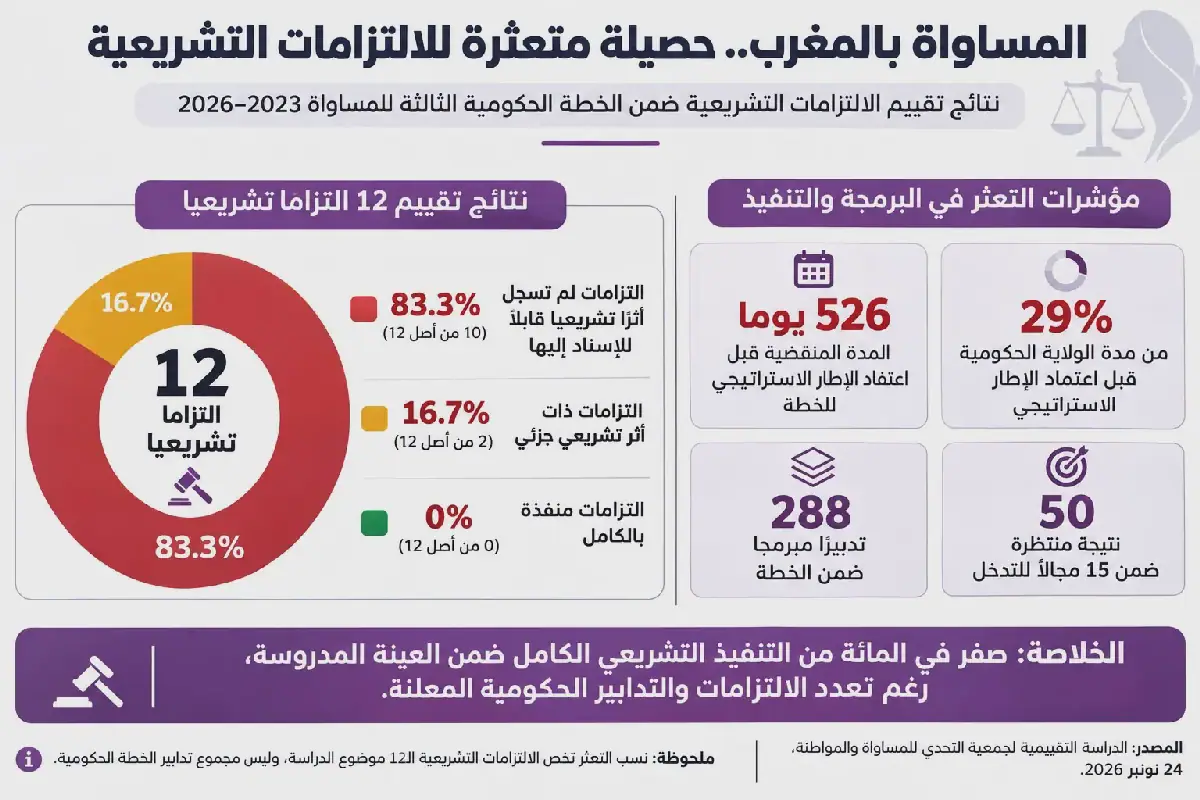
A recent study by the Challenge for Equality and Citizenship association has revealed that Morocco's efforts to promote gender equality are being hindered by a lack of implementation of its legislative commitments. The study evaluated 12 commitments outlined in the government's third equality plan for 2023-2026 and found that none had been fully implemented. Only two commitments had a partial legislative impact, while 83.3% of the commitments had no discernible legislative effect.
The study's findings highlight a significant gap between the government's declared commitments to promoting women's rights and its ability to translate these commitments into effective legislative reforms. This is particularly evident in areas such as combating violence and discrimination, economic empowerment, and reducing child marriage. The study's results were presented at the second edition of the Institutional Dialogue Forum in Casablanca.
One of the key areas where implementation has been lacking is in the fight against violence against women. The study found that a government commitment to amend the law on combating violence against women had not resulted in a draft law being submitted to parliament. This is despite ongoing discussions about the limitations of the current law and the need for more robust protections.
The study also examined the status of other commitments, including those related to combating discrimination against women in the workplace, promoting economic independence, and reducing child marriage. In all these areas, the study found that commitments had not been translated into complete legislative reforms. However, the review of the penal code was cited as a case where legislative progress had been made, although it did not fully meet the commitment to reduce the deadlines for processing complaints.
The study identified several reasons for the lack of implementation, including delays in adopting the government's equality plan and a lack of coordination and governance. The plan was adopted in March 2023, 526 days after the start of the previous government's term, which is approximately 29% of its theoretical duration. The study argued that this delay, combined with the absence of an independent legislative agenda, had hindered the effective implementation of the plan's commitments.
In response to the study's findings, Hanane Rahab, national writer for the Unionist Women's Organization, called for a shift from political commitments to legislative and institutional obligations. She proposed several measures to develop the next government equality plan, including the adoption of a framework law on equality between women and men, which would define government commitments, sectoral responsibilities, and financing mechanisms.
The study's authors recommended conducting an official inventory of legislative commitments that were not completed during the previous government term and reprogramming them in the next legislative agenda with specific deadlines and responsibilities. They also called for subjecting draft laws to impact studies from a gender perspective and establishing a special mechanism to track the legislative progress of government commitments.
Key points
- The study evaluated 12 legislative commitments and found that none had been fully implemented.
- The lack of implementation has hindered progress in areas such as combating violence and discrimination against women.
- The study's authors are calling for a framework law on equality and more effective mechanisms for tracking and implementing government commitments.
Reporting sources
- المساواة بالمغرب.. 12 التزاما تشريعيا دون تنفيذ مكتمل · Al Ahdath Al Maghribia