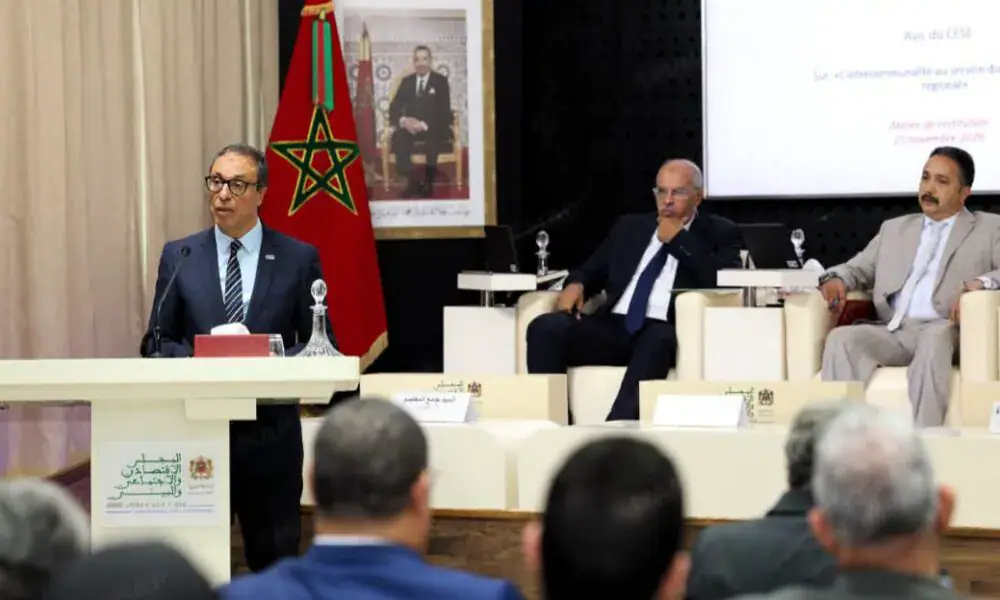
Morocco's Economic, Social and Environmental Council (CESE) has called for the swift completion of a national cooperation plan between territorial collectivities. The plan aims to strengthen complementarity and solidarity in territorial domains, improving public services and achieving integrated, sustainable development. CESE President Abdelkader Amara made the appeal during a workshop in Rabat, presenting conclusions and recommendations from the council's report, "Intercommunality in Service of Regional Development."
The council's report highlights that Morocco has made progress in strengthening the legal and institutional foundations of intercommunality, with 51 intercommunal cooperation establishments (ECI) and 120 territorial collectivity groups (GCT) established. These entities focus on areas such as waste management, transportation, and public services. However, Amara noted that the potential of intercommunality remains underutilized, with 53% of ECIs involved in waste management and 43% in transportation, while only 4% are involved in tourism, cultural animation, and heritage protection.
Amara identified several challenges hindering the effectiveness of ECIs and GCTs, including a lack of precise identification of common needs, inadequate project preparation, and unclear delineation of member collectivities' responsibilities. Insufficient financial, human, and technical resources also pose significant constraints. These challenges do not undermine the achievements but underscore the need to strengthen existing mechanisms and create conditions for their proper functioning.
The council's report emphasizes that the goal is to translate the common will to cooperate into feasible, sustainable projects with tangible impacts on public services and integrated, sustainable territorial development. Jamaâ El Moâtassim, a CESE member and rapporteur, presented the framework for addressing cooperation between territorial collectivities, focusing on intercommunal cooperation institutions, territorial collectivity groups, and various management mechanisms.
El Moâtassim discussed the challenges associated with managing common services and projects, including technical complexities, multiple stakeholders, and difficulties in monitoring contract execution, particularly when services are delegated to private operators. The council has recommended reinforcing the governance and effectiveness of ECIs and GCTs by ensuring their creation is based on finely identified cooperation needs and feasibility studies.
To enhance the viability of ECIs and GCTs, the council suggests securing member collectivities' contributions, diversifying funding sources, and ensuring better alignment between mobilized resources and investment needs. The council also stresses the importance of strengthening human and technical capacities by facilitating the mobilization and mutualization of qualified competencies and providing territorial engineering support for project design and implementation.
The council has called for reinforced legal frameworks for delegated and institutional management, conditioning the creation of development companies on prior evaluations of their relevance and added value. The council also recommends consolidating conditions for the successful deployment of regional multiservice companies by strengthening the capacities of concerned territorial collectivity groups to monitor contract execution and ensure stakeholder engagement.
Key points
- The council urges swift completion of the national cooperation plan to strengthen territorial development and public services.
- Morocco has established 51 intercommunal cooperation establishments and 120 territorial collectivity groups.
- The council recommends reinforcing governance, effectiveness, and financial viability of these entities.