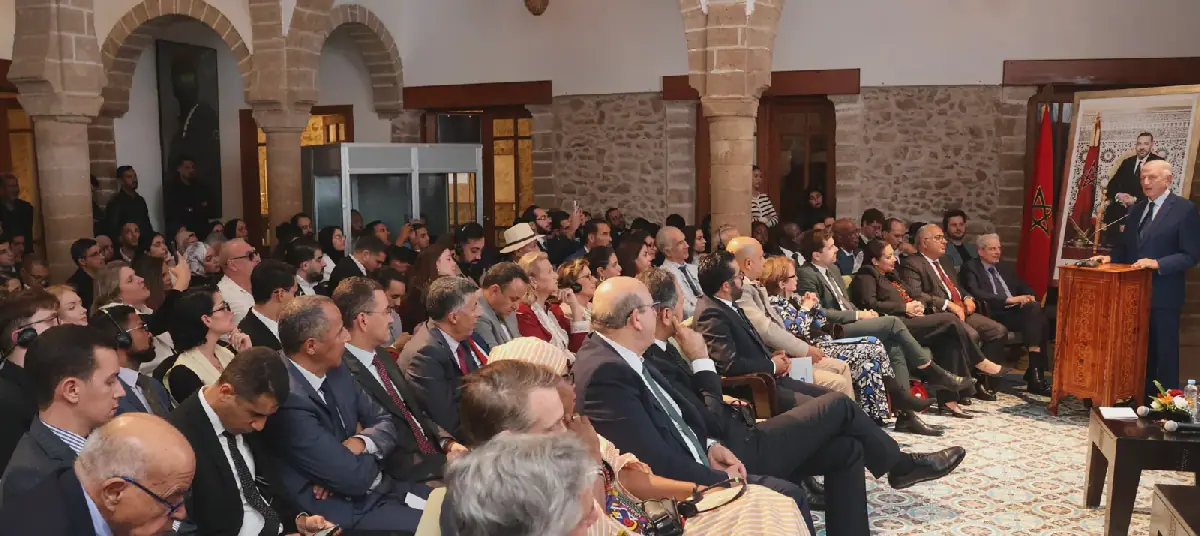
Morocco's economic development and positioning in international trade are rooted in its historical tradition of openness to different geographical and cultural spaces. This was a key message conveyed by Minister of Industry, Trade, Investment, and Economic Inclusion Ryad Mezzour during a meeting in Essaouira. The event was part of the first edition of the Mogador Essaouira Conversations, where Mezzour emphasized that Morocco's strategic orientations under King Mohammed VI's reign extend the country's historical role as a meeting point between Africa, Europe, and the Atlantic world.
Mezzour drew a parallel between Essaouira's commercial role in the 18th century and current maritime infrastructure projects in Morocco. He recalled that Mogador was a significant passage point between Africa and Europe during the reign of Sultan Sidi Mohammed Ben Abdallah. The city had commercial relations with sub-Saharan Africa through routes connecting Morocco to Timbuktu, contributing to its development as a commercial hub. Mezzour noted that this historical function is being prolonged through major port projects currently being developed in Morocco, including those in Tanger, Nador, and Dakhla.
These infrastructure projects aim to strengthen Morocco's connections with regional and international economic spaces and expand its commercial exchange capacities. Mezzour presented the development of Morocco's maritime facades as a component of its economic and industrial strategy. He also emphasized Morocco's geographical position, located at the junction of Africa, Europe, the Atlantic Ocean, and the Mediterranean, near the Strait of Gibraltar. This location is a significant advantage that Morocco seeks to capitalize on through its development choices and international openness.
Mezzour also addressed the economic, technological, and geopolitical transformations currently affecting the world. He mentioned the consequences of climate change, the rapid development of artificial intelligence, and the reconfigurations of international balances. According to Mezzour, these developments raise new questions about development models and how societies can reconcile economic progress, technological innovation, and environmental protection.
The meeting was attended by Advisor to the King and founder of the Essaouira-Mogador Association, André Azoulay, as well as several speakers from different backgrounds. The event was held under the theme "When economic power meets the consciousness of civilizations." Mezzour's statements highlight Morocco's commitment to leveraging its strategic position and historical experience to drive economic development and international cooperation.
The minister's emphasis on international openness reflects Morocco's efforts to strengthen its economic ties with other countries and regions. By developing its maritime infrastructure and promoting trade, Morocco aims to increase its economic competitiveness and integration into the global economy. This approach is part of a broader strategy to diversify Morocco's economy and reduce its dependence on traditional industries.
As Morocco continues to navigate the complexities of the global economy, its commitment to international openness and cooperation is likely to remain a key aspect of its economic development strategy. By building on its historical strengths and investing in new infrastructure and technologies, Morocco aims to achieve sustainable economic growth and improve its position in the global economy.
Key points
- Morocco's economic development strategy emphasizes international openness and cooperation to drive growth and competitiveness.