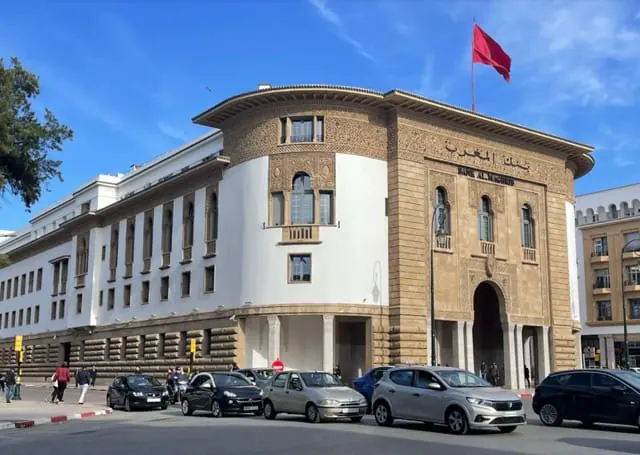
Morocco's central bank, Bank Al-Maghrib, has decided to keep its key interest rate unchanged at 2.25% during its third quarterly meeting of 2026. The decision was made in a context of low inflation and rising external pressures on energy and raw material prices, amid ongoing geopolitical uncertainty. The bank's governor, Abdellatif Jouahri, was scheduled to hold a press conference after the meeting but it was cancelled to maintain institutional neutrality ahead of legislative elections.
The bank noted that inflation in Morocco has remained low, averaging 0.3% during the first eight months of the year, supported by a decline in some food prices. The bank expects inflation to reach 0.7% by the end of 2026 and then rise to 1.5% in 2027, driven by its core component after the impact of some food components, such as olive oil prices, fades. Inflation expectations remain stable, with financial sector experts surveyed by the bank expecting an average inflation rate of 2.1% over the next eight quarters and 2.2% over the next 12 quarters.
The bank expects Morocco's economic growth to slow down from 4.9% in 2025 to 4.4% in 2026 and then to 2.9% in 2027. The bank forecasts a 16% increase in agricultural value added this year, driven by a good harvest, before a 7.6% decline in 2027, assuming a return to an average production of 50 million quintals. Non-agricultural activities are expected to slow down from 4.5% in 2025 to 3.1% in 2026 and then rise to 4% in 2027.
Despite the slowdown in growth, the labor market has continued to show dynamism. According to the High Commission for Planning, 406,000 jobs were created on an annual basis during the second quarter of 2026, with the unemployment rate declining to 9.5% overall. The bank also noted that the global economy has remained relatively resilient, supported by increased public spending and investments related to artificial intelligence and defense.
The bank highlighted the risks and uncertainties surrounding the global economic outlook, including rising tensions in the Middle East and ongoing conflicts in Ukraine, which have led to disruptions in production and supply chains, particularly in energy and food. The bank expects the global economy to slow down from 3.2% in 2025 to 3% in 2026 and then 2.9% in 2027.
On the external front, the bank expects Morocco's current account deficit to widen from 2.4% of GDP in 2025 to 4.6% in 2026 before declining to 3% in 2027. The bank also forecasts a decline in the country's foreign exchange reserves to 502.8 billion dirhams by the end of 2026 and 515.3 billion dirhams by the end of 2027.
The bank will continue to closely monitor the evolution of the economic situation and make decisions based on updated data. The level of uncertainty surrounding the outlook remains high due to geopolitical tensions and concerns about energy and food supplies, as well as the impact of climate change.
Key points
- Morocco's central bank keeps interest rate unchanged at 2.25%
- Inflation expectations remain stable, with experts expecting an average inflation rate of 2.1% over the next eight quarters
- The bank expects Morocco's economic growth to slow down from 4.9% in 2025 to 4.4% in 2026 and then to 2.9% in 2027